
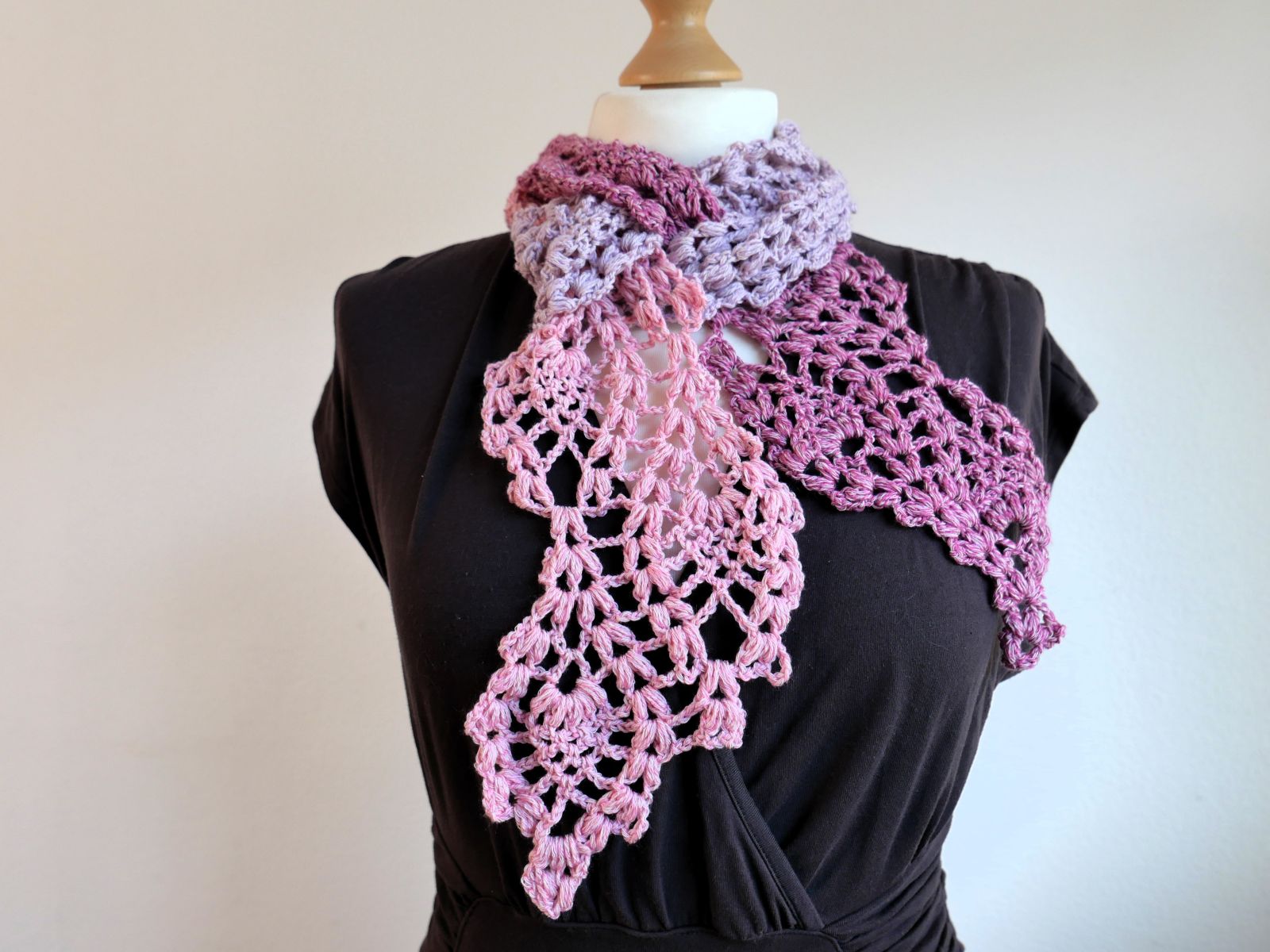
The pineapple stitch has long been one of my absolute favorite patterns – even though I’ve only created a few of my own designs with it so far. That is about to change: little by little, I’ll be sharing some new free pineapple-stitch patterns here on the blog. And there will also be selected designs available as paid patterns in my shop.
Of course, all of this takes time, so I’m asking you, my fellow yarn enthusiast, to be a little patient with me.
Few crochet patterns are as versatile as the pineapple stitch. You’ll find this decorative motif in tablecloths, triangular shawls, scarves, tunics, mandalas, and so much more. It has simply become part of the world of needlework.
But did you know where the pineapple motif actually comes from – and what lies behind the stylized “pineapple” we see in so many designs?
From South America to Europe
The pineapple is native to tropical South America, particularly the regions that are now Brazil, Paraguay, and Argentina.
During his second voyage in 1493, Christopher Columbus was given the fruit by local people and subsequently brought it to Europe.
For a long time, pineapples were an extremely rare luxury. They were expensive, difficult to transport, and notoriously difficult to grow. For centuries, they were largely reserved for the wealthy and became a symbol of wealth and exclusivity. It was not until the late 17th century that successful cultivation in European greenhouses became possible.
There is an important aspect to this story, too: the spread of the pineapple is closely connected to European colonial history. The wealth and status associated with the fruit in Europe were also tied to exploitation, forced labor, and the dispossession of Indigenous peoples. So the pineapple is not only a symbol of the exotic – it also reminds us of the human cost behind this history.
A Symbol of Wealth and Hospitality
During the 17th and 18th centuries, the pineapple became a status symbol in Europe, particularly in England. It came to represent wealth, sophistication, hospitality, and luxury.
At lavish gatherings, pineapples were used to decorate tables. In architecture, they appeared on gateposts, façades, furniture, and all kinds of beautifully crafted objects. One famous example is the Scottish landmark The Pineapple, built in 1761, whose dome was designed to look like a gigantic pineapple.
It is worth taking a closer look at this history: a symbol that came to represent hospitality and welcome also became popular within a system shaped by inequality and exploitation.
From Architectural Motif to Crochet Pattern
Over time, the pineapple motif made its way from architecture into decorative arts and textiles. It became particularly popular in the 19th century, appearing in pattern books and needlework magazines. In Victorian lacework, the so-called “Pineapple Pattern” quickly became a familiar feature of pattern collections.
The motif remained popular throughout the 20th century. During the 1940s and 1950s, tropical designs were especially fashionable in the United States, influenced in part by the so-called Tiki trend and its romanticized vision of the South Seas. This often created a simplified image of other cultures – more fantasy than reality.
The Pineapple Stitch in Crochet
In textile design, the pineapple motif eventually developed into a distinctive lace pattern of its own. From a crochet perspective, it is created using:
- fan-shaped groups of double crochet stitches
- chains and chain spaces
- an overall oval or teardrop shape
And here’s one of the reasons I love this pattern so much: it looks far more complicated than it actually is.
The pineapple stitch is made from basic crochet stitches such as chain spaces, double crochet stitches, and single crochet stitches, cleverly arranged to create the characteristic openwork design. When these elements come together, they form a delicate lace pattern that is both decorative and wonderfully harmonious.
The pattern was particularly popular between around 1890 and 1930, and again from the 1950s through the 1970s. Many households had crocheted doilies featuring pineapple motifs – little pieces that represented care, craftsmanship, and the love that went into creating a beautifully decorated home.
.JPG)
A Pattern Between Beauty and History
The pineapple stitch stands for intricate craftsmanship, patience, precision, tradition, and decorative elegance. At the same time, it reminds us of its deeper meaning: the pineapple as a symbol of hospitality, combined with a handmade piece that expresses warmth and care.
So how do we approach it today? You certainly don’t have to stop crocheting the pattern. Instead, you can simply be aware of its history. The pineapple is not only a symbol of welcome and generosity, but also part of a global history shaped by trade, power, and inequality – and both sides of that story matter.
At the same time, there are some positive developments. Today, projects are turning the fibers of the pineapple plant – which were often burned or discarded in the past – into yarns and textiles. In this way, tradition meets sustainability and shows that craftsmanship and conscious choices can go hand in hand.
Perhaps that is where the true depth of the pineapple stitch lies:
A pattern that is not only beautiful, but also invites you to pause and reflect – and one that deserves to be approached with awareness and appreciation.


