Introduction and Overview
Double knitting is a unique technique in which two interconnected layers of fabric are created simultaneously. The special feature: both sides of the knitted piece can display different patterns and colors. This results in a reversible item with no distinct "wrong" or back side.
The principle relies on the fact that, in every row, stitches are paired—one for the front layer and one for the back. Depending on the desired pattern, these stitches are worked as knits or purls, which serves to join the two layers together. In classic double knitting, two colors are typically used, meaning the pattern appears on the reverse side with an inverted color scheme.
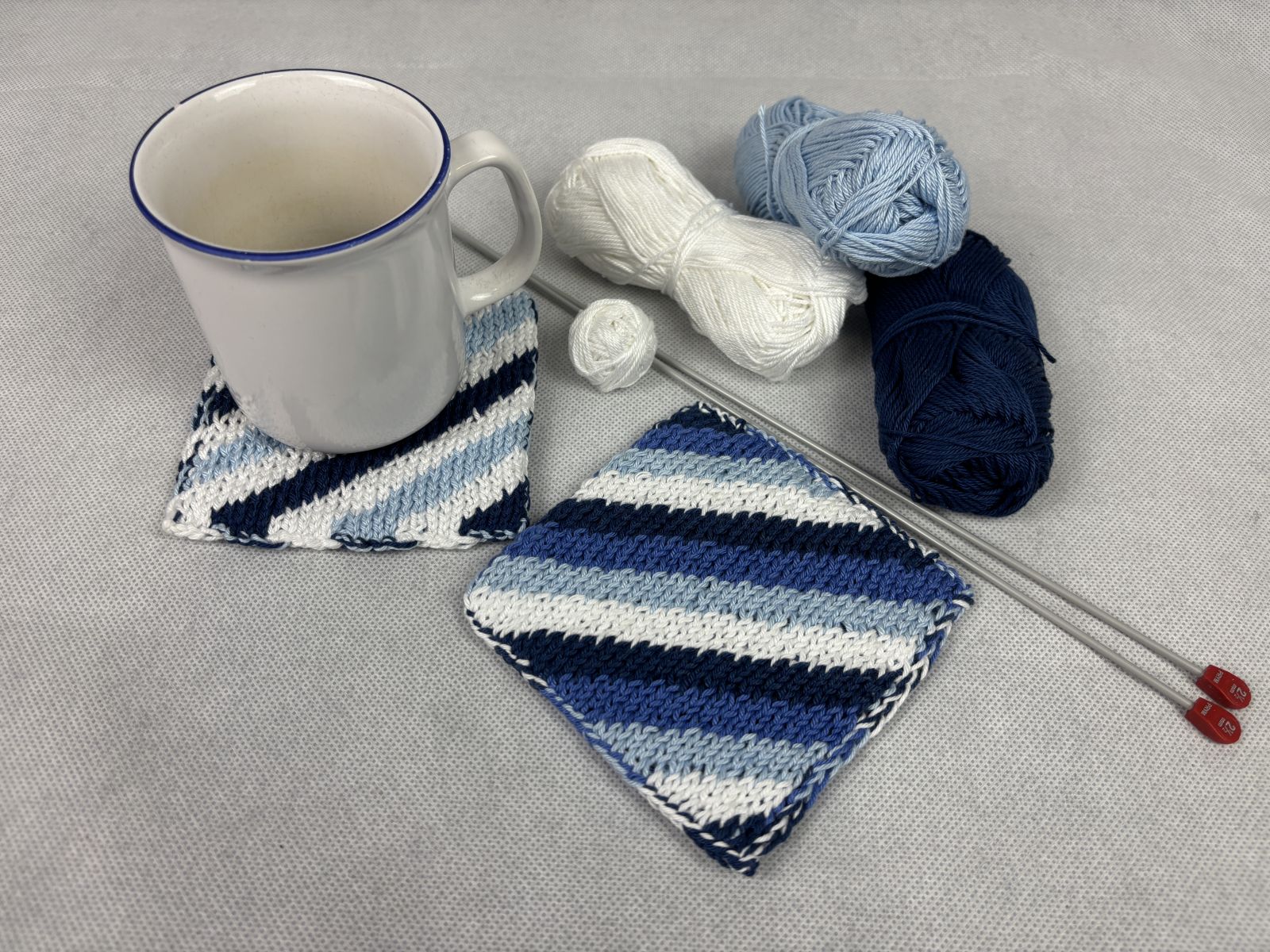
Things get even more exciting when you go beyond the traditional two-color approach; with an adapted technique, it is possible to incorporate three or even four colors into a double-face project. I will show you how this works using two different types of coasters.
How Can More than Two Colors be Used in Double Knitting?
Basic Principle
For each of the two sides of the fabric, you can carry an additional yarn strand. This means you are working with a total of four active strands in three or four different colors, allowing you to create additional blocks of color on both the front and the back. In this way, you can produce knitted pieces that feature three or four distinct colors.
However, this technique does have a minor drawback: because four yarn strands are carried simultaneously, the resulting fabric becomes somewhat thicker and firmer. It is therefore particularly well-suited for projects where a soft drape is not a priority—such as placemats, coasters, or mousepads.
Cast on Using 4 Working Strands
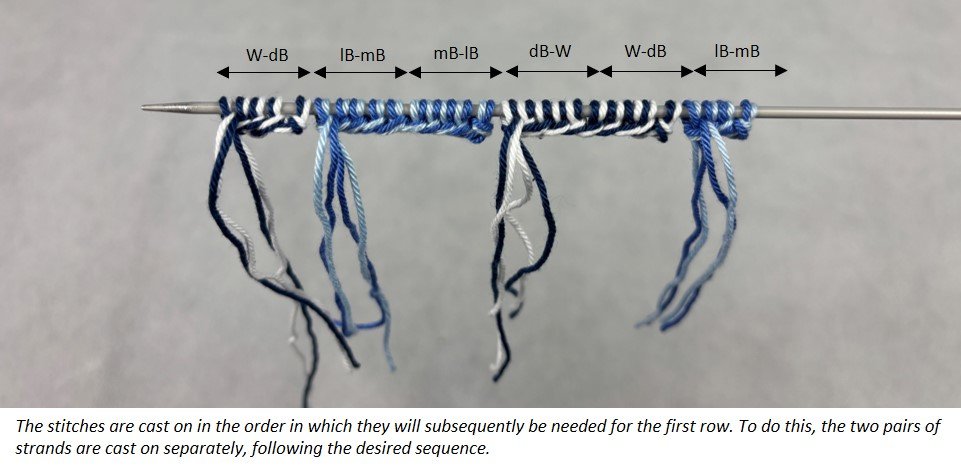
To ensure that all four colors can be used for knitting right from the first row, the stitches are cast on in the order in which they will be needed for that first row.
To achieve this, the two pairs of yarns are cast on separately, following the desired sequence. These initially separate sets of stitches are then joined together during the first knitted row.
Double Knitting with 4 Working Strands
In double knitting with four working strands, the fundamental principle remains the same as in classic two-color double-face knitting: you always work with two strands simultaneously—one for the front side of your project and one for the back.
The difference is that you carry two additional strands along as well. In total, you are working with four strands, organized into two pairs—for example:
• Pair 1: Dark blue and white
• Pair 2: Light blue and medium blue
Each pair consists of two contrasting colors, which form the front and back of the same section of the fabric. This means that if you knit a section in dark blue on the front, it will appear in white on the back; if you knit a section in light blue, it will appear in medium blue on the back.
It is important to note that you only ever knit with one pair of strands at a time. The other pair is carried along without being knitted. To do this, you simply drape the two strands not currently in use over your fingers, ensuring they end up positioned between the two layers of the fabric.
Essentially, you alternate between the two pairs of strands, with one pair being knitted while the other is carried along. This technique allows you to use four different colors in your double knitting, enabling you to create distinct color patterns on both the front and the back of your work.
To Ensure there are no Knots in Your Fingers or the Yarn
To begin with: it takes a bit of practice to get the hang of handling four strands of yarn. So, don’t give up too soon! As you gain more experience, it will become easier—and knitting with four colors will become even more enjoyable.
There is no single "correct" way to hold the strands over your fingers. It’s best to experiment a little until you find a grip that feels comfortable for you. Here are my recommendations:
- Keep the strands as separate as possible: Guide the two strands that are not currently being knitted together between your index finger and middle finger. Position the strand intended for the front side between your thumb and index finger, and the strand for the back side between your middle and ring fingers. This keeps the four strands well-separated and easier to control.
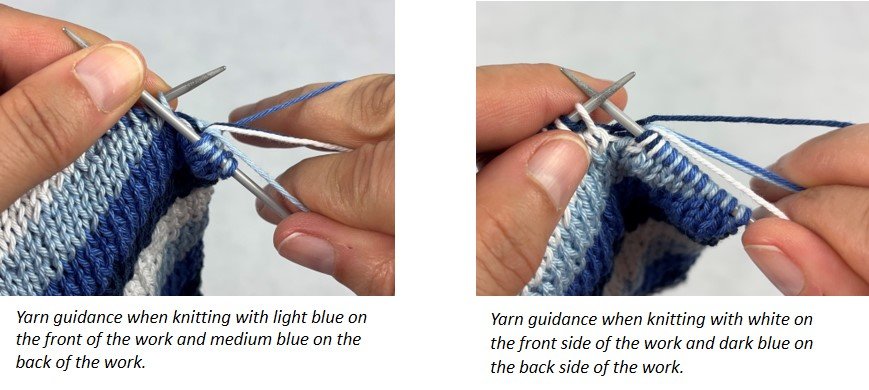
- Keep your yarn balls organized: Ensure that each ball has enough space and that the strands do not become twisted together. Especially when changing colors, it is worth pausing for a moment to untangle the strands if necessary. This prevents knots from forming over time
Basic Principles of Thread Guidance
Although you only ever knit with one pair of strands at a time, double knitting involves handling all four strands together throughout the process.
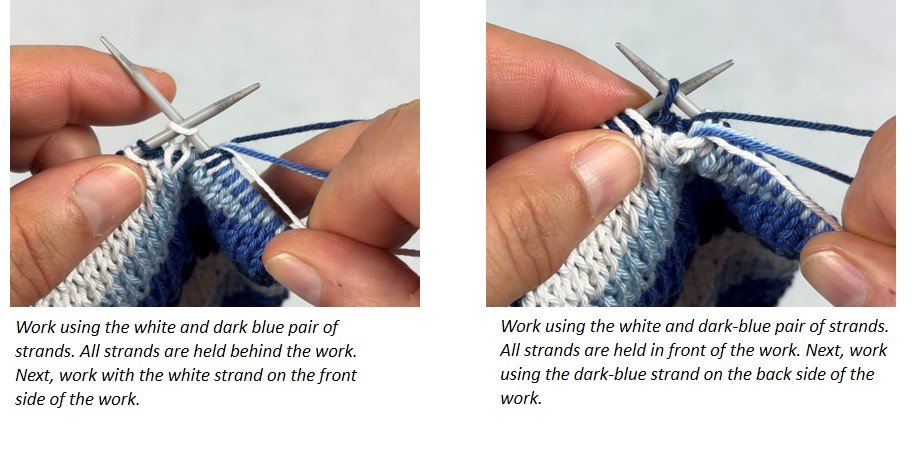
When knitting the front side of the work, you position all four yarns toward the back. When you then knit the back side, you bring all four yarns toward the front.
In each case, only the two yarns belonging to the pair currently in use are knitted. The other two yarns—those not being used at that moment—lie between the two layers of fabric. This keeps them concealed on the inside of the work, ensuring they remain invisible from the outside.
How to Knit the Edge Stitches
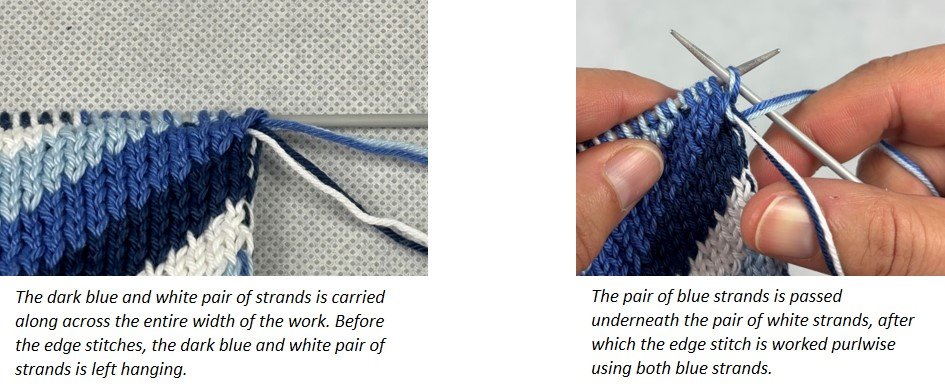
Both pairs of strands are carried along across the entire width of the work. At the end of a row, the pair of strands that was not used last is left ‘hanging’ before the edge stitch.
Then, pass the pair of strands that was just used underneath the pair that was left hanging (see photo below). This ensures that the unused pair of strands is enclosed between the two layers of fabric when transitioning to the next row, keeping it neatly hidden along the edge of the work.
To Prevent the Work from Shrinking
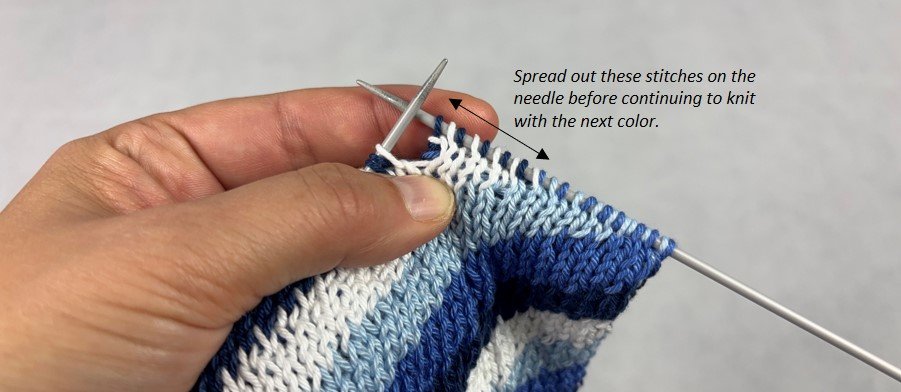
Make sure that the unused strands of yarn carried along between the different color sections are not pulled too tight. If they are too taut, the fabric may contract, causing it to become unintentionally narrow.
To avoid this, I recommend spreading out the stitches of the color block you just finished knitting along the needle before switching to the next color. This ensures that the carried-along strands have enough slack, keeping the fabric nice and relaxed.
Casting Off with 4 Working Strands
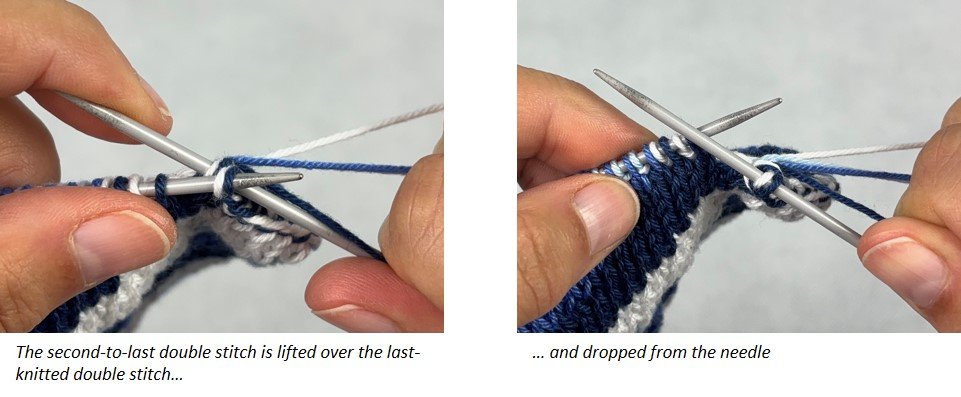
To create a neat, clean edge, the bind-off row is worked in the same way as the main body of the knitted piece.
After each double stitch worked, the previously worked double stitch is lifted over the newly worked one and dropped off the needle.
In this way, all four working yarns are carried along throughout the entire bind-off row, while simultaneously being neatly concealed within the edge.
How to Weave in the Yarn Ends at the Cast-on Edge
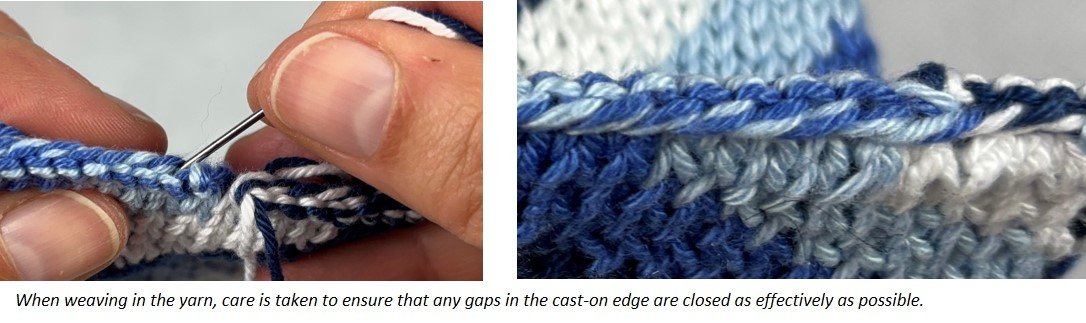
Since the two pairs of strands were cast on separately and alternately—and only joined together in the first knitted row—small gaps occur along the cast-on edge between the original pairs of strands.
When weaving in the yarn ends, it is therefore advisable to close these small gaps as effectively as possible, ensuring the edge looks as uniform and neat as possible.
Knitting: ‘Ocean Breeze’ Coaster
Material
- Katia Capri, Schachenmayr Catania, or a yarn with a similar yardage (125m/50g): approx. 5g per color. Depending on your personal knitting style, the amount used may vary slightly.
- Knitting needles, size 2.5 mm (US 1.5)
- Scissors and a tapestry needle
Stitch Gauge
Double knitted using 4 working strands: 28 stitches x 29 rows = 10 cm x 10 cm.
With this gauge, the coaster will measure approximately 11.5 cm x 11.5 cm.
Yarn Pair Definition
- Yarn pair 1: Dark blue and whit
- Yarn pair 2: Medium blue and light blue
Counting Chart
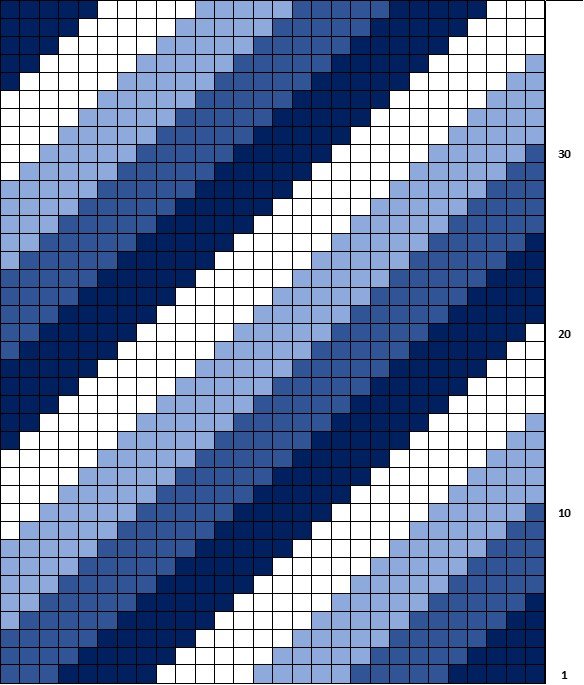
This chart shows the front side of the work. On the back side, the respective contrasting colors are used (see the definition of yarn pairs). Please note that the edge stitches are not included in the chart.
Row by Row Description
Abbreviations
|
est |
: edge stitch |
|
W |
: white |
|
dB |
: dark blue |
|
lB |
: light blue |
|
mB |
: medium blue |
The following description always refers to the knit stitches on the side of the work facing you. The purl stitches are worked in the respective contrasting color (see the definition of "yarn pair"); these are not mentioned in the description.
|
Casting on |
Cast on a total of 30 double stitches. Work the first 4 stitches in the sequence lB-mB, the next 5 stitches in the sequence W-dB, then 5 stitches in the sequence dB-W, 5 stitches in the sequence mB-lB, 5 stitches in the sequence lB-mB, and the final 6 stitches in the sequence W-dB. |
|
Row 1 |
est / 5 dB / 5 mB / 5 lB / 5 W / 5 dB / 3 mB / est |
|
Row 2 |
est / 4 lB / 5 W / 5 dB / 5 mB / 5 lB / 4 W / est |
|
Row 3 |
est / 3 dB / 5 mB / 5 lB / 5 W / 5 dB / 5 mB / est |
|
Row 4 |
est / 1 mB / 5 lB / 5 W / 5 dB / 5 mB / 5 lB / 2 W / est |
|
Row 5 |
est / 1 dB / 5 mB / 5 lB / 5 W / 5 dB / 5 mB / 2 lB / est |
|
Row 6 |
est / 3 mB / 5 lB / 5 W / 5 dB / 5 mB / 5 lB / est |
|
Row 7 |
est / 4 mB / 5 lB / 5 W / 5 dB / 5 mB / 4 lB / est |
|
Row 8 |
est / 5 mB / 5 lB / 5 W / 5 dB / 5 mB / 3 lB / est |
|
Row 9 |
est / 2 mB / 5 lB / 5 W / 5 dB / 5 mB / 5 lB / 1 W / est |
|
Row 10 |
est / 2 dB / 5 mB / 5 lB / 5 W / 5 dB / 5 mB / 1 lB / est |
|
Row 11 |
est / 5 lB / 5 W / 5 dB / 5 mB / 5 lB / 3 W / est |
|
Row 12 |
est / 4 dB / 5 mB / 5 lB / 5 W / 5 dB / 4 mB / est |
|
Row 13 |
est / 3 lB / 5 W / 5 dB / 5 mB / 5 lB / 5 W / est |
|
Row 14 |
est / 1 W / 5 dB / 5 mB / 5 lB / 5 W / 5 dB / 2 mB / est |
|
Row 15 |
est / 1 lB / 5 W / 5 dB / 5 mB / 5 lB / 5 W / 2 dB / est |
|
Row 16 |
est / 3 W / 5 dB / 5 mB / 5 lB / 5 W / 5 dB / est |
|
Row 17 |
est / 4 W / 5 dB / 5 mB / 5 lB / 5 W / 4 dB / est |
|
Row 18 |
est / 5 W / 5 dB / 5 mB / 5 lB / 5 W / 3 dB / est |
|
Row 19 |
est / 2 W / 5 dB / 5 mB / 5 lB / 5 W / 5 dB / 1 mB / est |
|
Row 20 |
est / 2 lB / 5 W / 5 dB / 5 mB / 5 lB / 5 W / 1 dB / est |
|
Row 21-36 |
Repeat rows 1-16 one time |
|
Binding off |
Bind off all stitches. In doing so, follow the color sequence used in row 17 |
Knitting: ‘Winter Sky’ Coaster
Material
- Katia Capri, Schachenmayr Catania, or a yarn with a similar yardage (125m/50g): approx. 5g of each blue color and approx. 10g of white. Depending on your personal knitting style, the amount required may vary slightly.
- Knitting needles, size 2.5 mm (US 1.5)
- Scissors and a tapestry needle
Stitch Gauge
Double knitted using 4 working strands: 28 stitches x 29 rows = 10 cm x 10 cm.
With this gauge, the coaster will measure approximately 11.5 cm x 11.5 cm.
Yarn Pair Definition
- Yarn pair 1: dark blue and light blue
- Yarn pair 2: white and white
Counting Chart
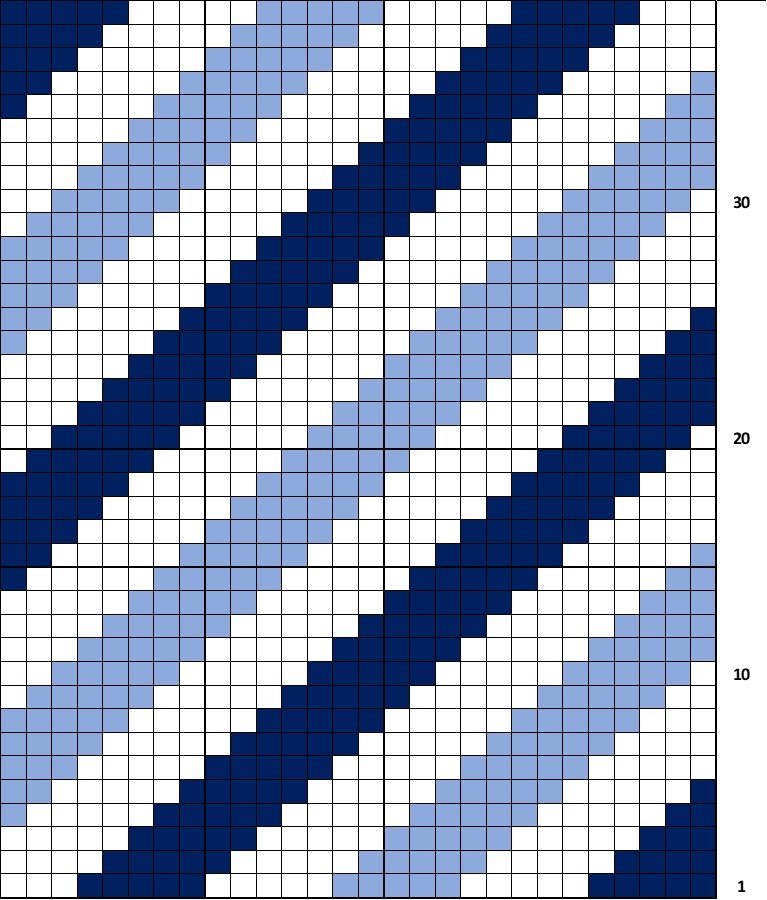
This chart shows the front side of the work. On the back side, the respective contrasting colors are used (see the definition of yarn pairs). Please note that the edge stitches are not included in the chart.
Row by Row Description
Abbreviations
|
est |
: edge stitch |
|
W |
: white |
|
dB |
: dark blue |
|
lB |
: light blue |
The following description always refers to the knit stitches on the side of the work facing you. The purl stitches are worked in the respective contrasting color (see the definition of "yarn pair"); these are not mentioned in the description.
|
Casting on |
Cast on a total of 30 double stitches. Work the first 4 stitches in the sequence W-W, the next 5 stitches in the sequence lB-dB, then 5 stitches in the sequence W-W, 5 stitches in the sequence dB-lB, 5 stitches in the sequence W-W, and the final 6 stitches in the sequence lB-dB. |
|
Row 1 |
est / 5 dB / 5 W / 5 lB / 5 W / 5 dB / 3 W / est |
|
Row 2 |
est / 4 W / 5 lB / 5 W / 5 dB / 5 W / 4 lB / est |
|
Row 3 |
est / 3 dB / 5 W / 5 lB / 5 W / 5 dB / 5 W / est |
|
Row 4 |
est / 1 dB / 5 W / 5 lB / 5 W / 5 dB / 5 W / 2 lB / est |
|
Row 5 |
est / 1 dB / 5 W / 5 lB / 5 W / 5 dB / 5 W / 2 lB / est |
|
Row 6 |
est / 3 dB / 5 W / 5 lB / 5 W / 5 dB / 5 W / est |
|
Row 7 |
est / 4 W / 5 lB / 5 W / 5 dB / 5 W / 4 lB / est |
|
Row 8 |
est / 5 dB / 5 W / 5 lB / 5 W / 5 dB / 3 W / est |
|
Row 9 |
est / 2 W / 5 lB / 5 W / 5 dB / 5 W / 5 lB / 1 W / est |
|
Row 10 |
est / 2 W / 5 dB / 5 W / 5 lB / 5 W / 5 dB / 1 W / est |
|
Row 11 |
est / 5 lB / 5 W / 5 dB / 5 W / 5 lB / 3 W / est |
|
Row 12 |
est / 4 W / 5 dB / 5 W / 5 lB / 5 W / 4 dB / est |
|
Row 13 |
est / 3 lB / 5 W / 5 dB / 5 W / 5 lB / 5 W / est |
|
Row 14 |
est / 1 lB / 5 W / 5 dB / 5 W / 5 lB / 5 W / 2 dB / est |
|
Row 15 |
est / 1 lB / 5 W / 5 dB / 5 W / 5 lB / 5 W / 2 dB / est |
|
Row 16 |
est / 3 lB / 5 W / 5 dB / 5 W / 5 lB / 5 W / est |
|
Row 17 |
est / 4 W / 5 dB / 5 W / 5 lB / 5 W / 4 dB / est |
|
Row 18 |
est / 5 lB / 5 W / 5 dB / 5 W / 5 lB / 3 W / est |
|
Row 19 |
est / 2 W / 5 dB / 5 W / 5 lB / 5 W / 5 dB / 1 W / est |
|
Row 20 |
est / 2 W / 5 lB / 5 W / 5 dB / 5 W / 5 lB / 1 W / est |
|
Row 21-36 |
Repeat rows 1-16 one time |
|
Binding off |
Bind off all stitches. In doing so, follow the color sequence used in row 17 |


