
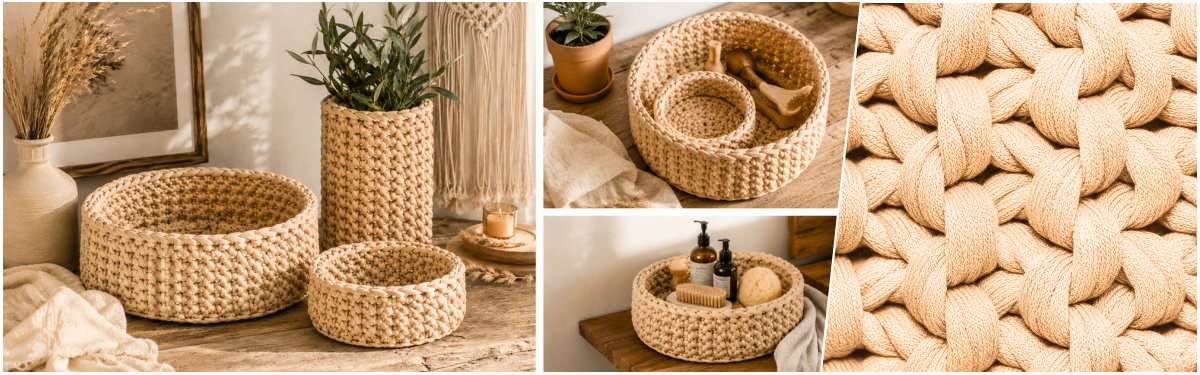
There are designs that sit quietly in your archive for years – almost forgotten – until one day you look at them again and suddenly think:
“Wait a second… this actually feels incredibly modern again.”
That’s exactly what happened to me recently while revisiting one of my older homeware patterns.
Large textile baskets.
Chunky textures.
Oversized stitches.
Home accessories made from textile yarn.
And the longer I looked at those older designs, the more I realized something:
The line between handmade crafts and modern interior design is becoming increasingly blurred.
Because while crocheted baskets, macramé, and textile home accessories are everywhere right now, knitted interior pieces still appear far less often – and that’s exactly what makes them feel so interesting at the moment.
Especially large garter-stitch textures suddenly feel surprisingly contemporary today.
They almost resemble:
- high-end interior fabrics,
- modern designer textiles,
- soft textile storage pieces,
- or calm boutique-style interiors.
What becomes particularly interesting is when both techniques are combined.
A crocheted base provides structure and stability, while the knitted upper section creates a softer, more textile-like texture.
The result feels completely different from traditional crochet baskets.
Less typical DIY – more calm, modern interior aesthetics.
And maybe that’s exactly why these projects fit so well into today’s living trends.
Because modern interiors are no longer only about perfectly polished surfaces.
What we see everywhere today are:
- visible materials,
- tactile textures,
- natural surfaces,
- warm neutral tones,
- and intentionally imperfect details.
Large stitches often feel:
- soft,
- calm,
- organic,
- and effortlessly cozy.
And maybe that’s exactly why textile homeware resonates with so many people again today.
Especially in a world that feels increasingly digital and fast-paced, visible textures and handmade materials create something many homes are missing right now:
A sense of calm.
Materials Matter: Why Textile Yarn Isn’t Always the Same
When working on large-scale homeware projects with oversized stitches, the yarn itself plays an especially important role.
Because textile yarn can vary significantly depending on the brand, material composition, and production process.
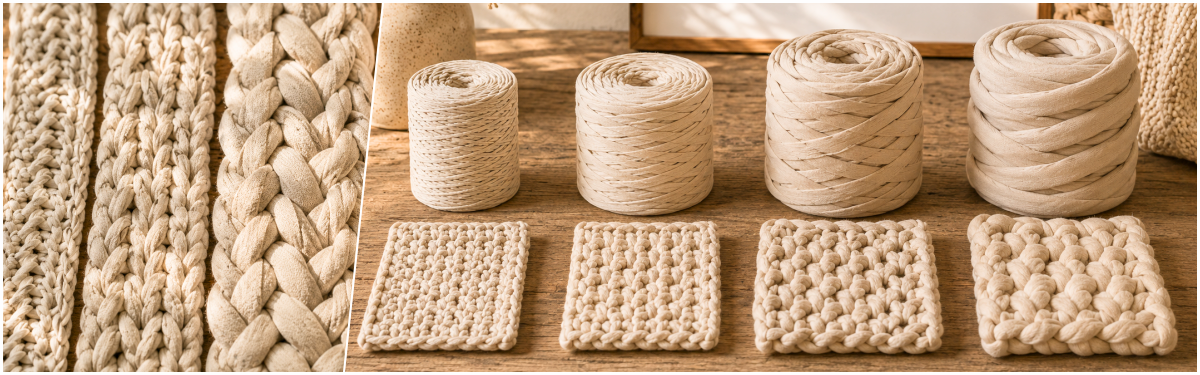
Some textile yarns feel:
- firmer,
- more elastic,
- heavier,
- or significantly softer than others.
The width of the yarn tape can also vary quite dramatically.
There are:
- narrow textile yarns,
- flat ribbon-style yarns,
- soft tubular yarns,
- or much thicker XXL variations.
And all of these differences directly influence:
- the final size of the project,
- its stability,
- the texture of the ridges,
- and most importantly, the overall knitted appearance.
Wider yarns often create a look that feels:
- chunkier,
- more rustic,
- and more compact.
Softer or narrower yarns, on the other hand, usually create:
- calmer stitches,
- softer transitions,
- and a much more textile-inspired, modern interior aesthetic.
Especially in garter stitch, the yarn itself completely changes the visual character of the finished piece.
That’s why it’s perfectly normal for projects to turn out slightly differently even when using the exact same pattern.
💡 Yarn Tip
For a calm, modern interior look, yarns with the following characteristics work especially well:
- natural shades,
- matte surfaces,
- and softer, more fluid textile yarns.
Very stiff or highly glossy yarns often create a look that feels more compact and graphic instead.
Colors Change Everything, Too
When I look back at older homeware projects today, I notice something else:
Color completely changes the overall feeling of a design.
Years ago, bold shades were especially popular:
- purple,
- bright pink,
- vibrant turquoise,
- or strong color contrasts.
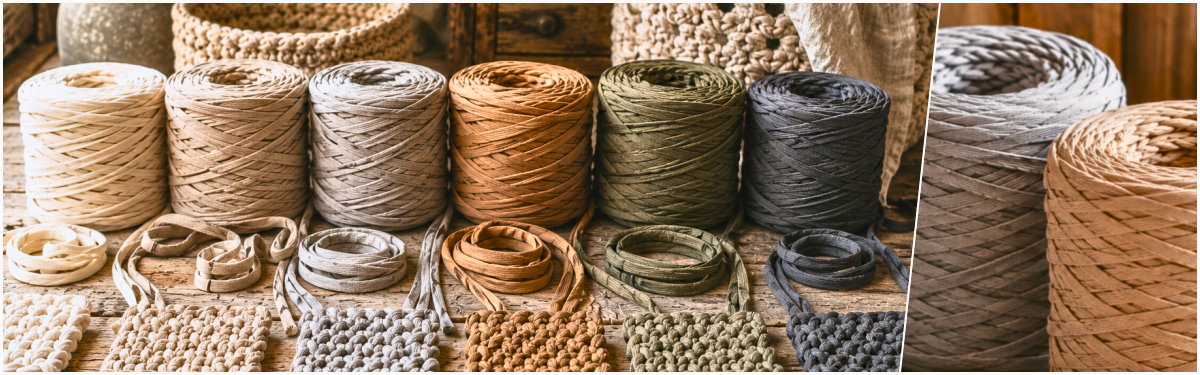
Today, however, modern interior projects tend to work best with calm, natural tones such as:
- greige,
- sand,
- linen,
- warm brown,
- sage,
- or deep olive.
Large stitches and textile textures often feel much more refined and sophisticated when combined with soft, muted shades.
And suddenly, a simple basket no longer looks like a traditional craft project – it starts to feel more like a small boutique-style interior piece.
That’s exactly why I didn’t want to simply republish the old pattern, but instead reinterpret it as a modern homeware collection.
Homeware Collection
Crocheted at the Bottom – Knitted at the Top
The combination of a sturdy crocheted base and a soft knitted upper section gives these homeware projects their unique character.
.png)
They are perfect for:
- living rooms,
- bathrooms,
- bedrooms,
- yarn storage,
- dried flowers,
- or calm slow-living decor.
And the best part is this:
Once you understand the basic concept, you can create almost endless variations in different shapes and sizes.
The collection includes three different designs, all based on the same idea:
- a crocheted base,
- combined with a knitted upper section.
And that’s exactly what makes these projects so versatile.
Pattern Instructions
To help you recreate the projects yourself, you’ll find the complete instructions here for:
- a small bowl,
- a large bowl,
- and a slim vase.
As mentioned earlier, all three designs are based on the same core concept:
a sturdy crocheted base combined with a soft knitted texture.
Materials Used
Hoooked Zpagetti Cotton Yarn
Color: Creamy Papaya
Yarn Amount
For:
- 1 large bowl,
- 1 small bowl,
- and 1 slim vase,
you will need approximately 600 g / 100 m (109 yds) of yarn in total.
Hook & Needle Sizes
Crochet hook: 6.0 mm (US J/10)
Knitting needles: 10.0 mm (US 15)
Gauge
in garter stitch
10 stitches = 10 cm / 4 inches
12 rows = 10 cm / 4 inches
Stitches & Techniques Used
Crochet Pattern
See the individual instructions for each project.
Knitting Pattern
Garter stitch
All stitches are knitted on both right-side and wrong-side rows.
Edge stitches are worked as slipped-edge stitches.
🧺 Small Bowl
(approx. 16 cm / 6.3 inches in diameter, approx. 6 cm / 2.4 inches high)
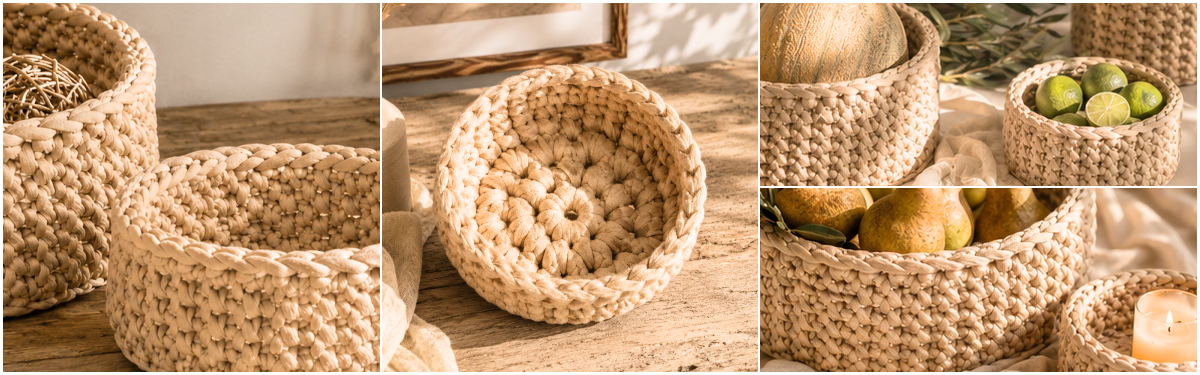
Base
Using a 6.0 mm crochet hook (US J/10), work a magic ring with 7 double crochet stitches (US Terms: 7 single crochet stitches) and close with 1 slip stitch.
Round 1
Work 2 double crochet stitches (US Terms: 2 single crochet stitches) into each stitch around
→ 14 stitches
Round 2
Repeat continuously:
[ 1 double crochet stitch (US Terms: 1 single crochet stitch), 2 double crochet stitches into the next stitch (US Terms: 2 single crochet stitches into the next stitch) ]
→ 21 stitches
Round 3
Repeat continuously:
[ 2 double crochet stitches (US Terms: 2 single crochet stitches), 2 double crochet stitches into the next stitch (US Terms: 2 single crochet stitches into the next stitch) ]
→ 28 stitches
Close the base with 1 slip stitch and weave in the yarn end.
Knitted Edge
Using 10.0 mm knitting needles (US 15), cast on 6 stitches.
Work continuously in garter stitch.
Always work the edge stitches as slipped-edge stitches.
After approximately 60 rows (= approx. 30 garter ridges), check whether the knitted section fits around the crocheted base.
💡 The total number of rows may vary slightly depending on your tension and personal knitting style.
While knitting, regularly place the knitted strip around the base to check the length.
Once the correct length is reached, sew the knitted section around the crocheted base from the outside using mattress stitch.
When the beginning and end of the knitted strip meet, do not cut the yarn. Instead, continue directly to close the open side seam neatly from bottom to top.
Finally, weave in all yarn ends carefully.
🧺 Large Bowl
(approx. 28 cm / 11 inches in diameter, approx. 10 cm / 4 inches high)
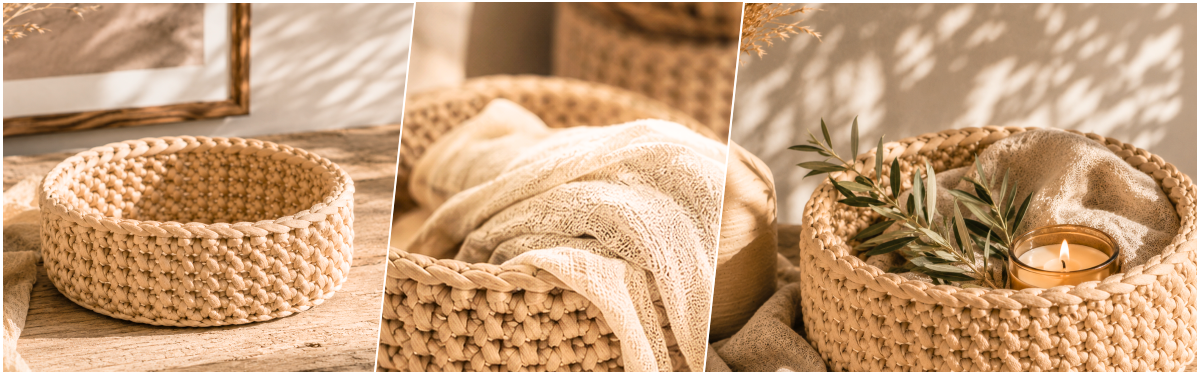
Base
Using a 6.0 mm crochet hook (US J/10), work a magic ring with 7 double crochet stitches (US Terms: 7 single crochet stitches) and close with 1 slip stitch.
Round 1
Work 2 double crochet stitches (US Terms: 2 single crochet stitches) into each stitch around
→ 14 stitches
Round 2
Repeat continuously:
[ 1 double crochet stitch (US Terms: 1 single crochet stitch), 2 double crochet stitches into the next stitch (US Terms: 2 single crochet stitches into the next stitch) ]
→ 21 stitches
Round 3
Repeat continuously:
[ 2 double crochet stitches (US Terms: 2 single crochet stitches), 2 double crochet stitches into the next stitch (US Terms: 2 single crochet stitches into the next stitch) ]
→ 28 stitches
Round 4
Repeat continuously:
[ 3 double crochet stitches (US Terms: 3 single crochet stitches), 2 double crochet stitches into the next stitch (US Terms: 2 single crochet stitches into the next stitch) ]
→ 35 stitches
Round 5
Repeat continuously:
[ 4 double crochet stitches (US Terms: 4 single crochet stitches), 2 double crochet stitches into the next stitch (US Terms: 2 single crochet stitches into the next stitch) ]
→ 42 stitches
Round 6
Repeat continuously:
[ 5 double crochet stitches (US Terms: 5 single crochet stitches), 2 double crochet stitches into the next stitch (US Terms: 2 single crochet stitches into the next stitch) ]
→ 49 stitches
Close the base with 1 slip stitch and weave in the yarn end.
Knitted Edge
Using 10.0 mm knitting needles (US 15), cast on 10 stitches.
Work continuously in garter stitch.
Always work the edge stitches as slipped-edge stitches.
After approximately 106 rows (= approx. 53 garter ridges), check whether the knitted section fits around the crocheted base.
💡 The total number of rows may vary slightly depending on your tension and personal knitting style.
While knitting, regularly place the knitted strip around the base to check the length.
Once the correct length is reached, sew the knitted section around the crocheted base from the outside using mattress stitch.
When the beginning and end of the knitted strip meet, do not cut the yarn. Instead, continue directly to close the open side seam neatly from bottom to top.
Finally, weave in all yarn ends carefully.
🪴 Slim Vase
(approx. 5–6 cm / 2–2.4 inches in diameter, approx. 15 cm / 6 inches high)
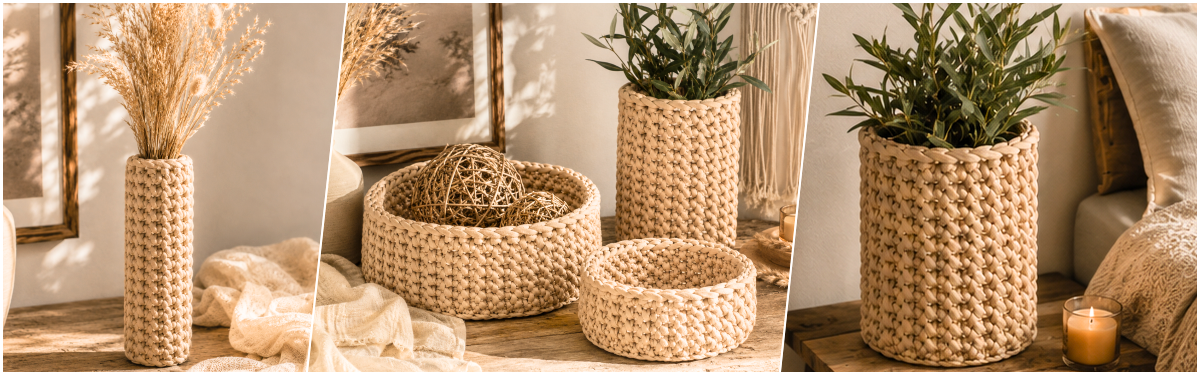
Base
Using a 6.0 mm crochet hook (US J/10), work a magic ring with 7 double crochet stitches (US Terms: 7 single crochet stitches) and close with 1 slip stitch.
Round 1
Work 2 double crochet stitches (US Terms: 2 single crochet stitches) into each stitch around
→ 14 stitches
Round 2
Repeat continuously:
[ 1 double crochet stitch (US Terms: 1 single crochet stitch), 2 double crochet stitches into the next stitch (US Terms: 2 single crochet stitches into the next stitch) ]
→ 21 stitches
Close the base with 1 slip stitch and weave in the yarn end.
Knitted Edge
Using 10.0 mm knitting needles (US 15), cast on 15 stitches.
Work continuously in garter stitch.
Always work the edge stitches as slipped-edge stitches.
After approximately 20 rows (= approx. 10 garter ridges), check whether the knitted section fits around the crocheted base.
💡 The total number of rows may vary slightly depending on your tension and personal knitting style.
While knitting, regularly place the knitted strip around the base to check the length.
Once the correct length is reached, sew the knitted section around the crocheted base from the outside using mattress stitch.
When the beginning and end of the knitted strip meet, do not cut the yarn. Instead, continue directly to close the open side seam neatly from bottom to top.
Finally, weave in all yarn ends carefully.
✨ Easily Adjust Sizes & Variations
Once you understand and practice the basic concept, you can create endless variations such as:
- larger bowls,
- taller baskets,
- wide storage trays,
- small textile baskets,
- or modern homeware decor pieces.
Simply combine:
- a larger crocheted base
with
- a wider and longer knitted section.
This allows you to create completely different shapes and sizes every time.
💡 Tip for Extra Stability
For a more structured and stable result, you can lightly treat the finished pieces with textile stiffening spray or fabric starch spray.
This helps the baskets:
- hold their shape better,
- feel more stable,
- and work especially well for larger homeware projects.
Important:
Only apply a light amount of stiffener so the soft textile look and feel of the yarn remains visible.
#FunFact: Textile Baskets Existed Long Before Instagram 😄
The idea of creating baskets or containers from textile materials is actually much older than today’s Pinterest, slow-living, or interior trends.
For centuries, households created textile storage solutions from whatever materials were available at the time:
- fabric strips,
- old clothing,
- plant fibers,
- cords,
- or leftover yarn.
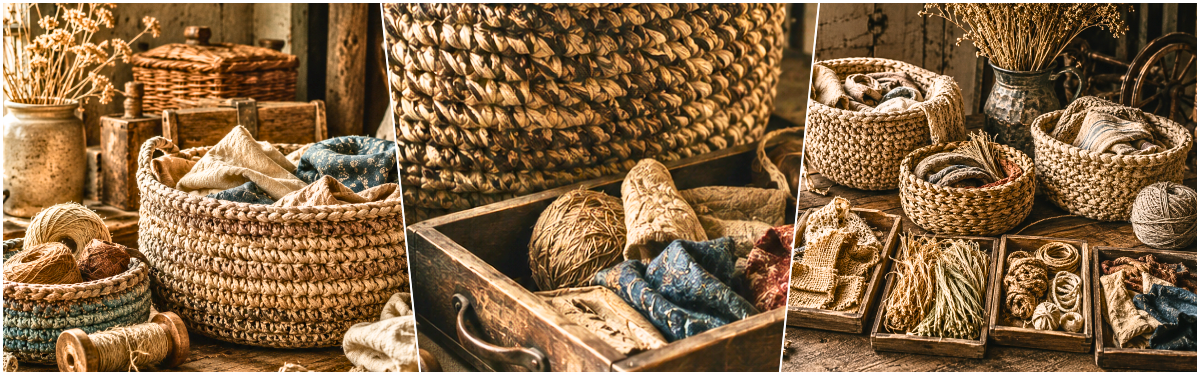
Especially during the 19th and early 20th centuries, practical baskets, bags, and storage pieces were often made from recycled materials – not as decorative design objects, but simply because they were useful in everyday life.
At a time when materials were valuable, almost everything was reused and repurposed.
What’s interesting is this:
Many of those historical techniques suddenly feel surprisingly modern again today.
Because the very things that were once purely practical now fit perfectly into current interior trends:
- visible materials,
- tactile textures,
- natural surfaces,
- and intentionally imperfect handmade details.
And there’s even a small psychological reason behind that.
Warm textile surfaces are often automatically perceived as:
- cozier,
- calmer,
- softer,
- and more comforting
than smooth or hard materials.
Maybe that’s why rooms filled with yarn, fabric, and visible textures often feel instantly more personal, peaceful, and relaxing.
Why Projects Like These Fit So Perfectly Into Everyday Creative Life
Maybe that’s exactly what makes homeware projects feel so special:
They combine creativity with the spaces we actually live in
Because in the end, you’re not just creating another handmade project — you’re creating something that:
- gets used,
- remains visible,
- and becomes part of everyday life.
Textile baskets, vases, and small storage pieces can completely change the atmosphere of a room with just a few simple details.
And perhaps that’s exactly why handmade homeware feels so appealing again today:
Large stitches, visible materials, and tactile textures are no longer just decorative elements – they become part of daily living itself.
Why Large Stitches Suddenly Feel Perfect for Our Time Again
Maybe we’re simply longing more than ever for:
- warmth,
- calm,
- visible materials,
- slower creativity,
- and objects with personality.
Especially in an increasingly digital world, handmade textures often feel like a conscious counterbalance to the fast pace of everyday life.
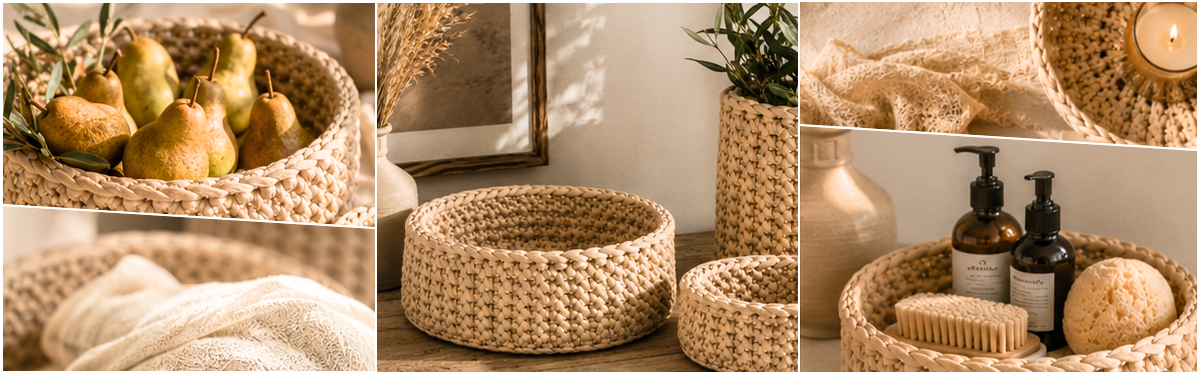
Because sometimes a design simply needs:
- a new perspective,
- softer colors,
- more modern living spaces,
- and a little distance in time,
before we suddenly realize how surprisingly modern it actually feels again 😄
Because large stitches, visible materials, and tactile textile textures often make a space feel instantly warmer, calmer, and more personal.
🧶 What Do You Think About Handmade Homeware?
Have you ever knitted or crocheted baskets, textile home accessories, or interior projects yourself?
Or are projects like these still sitting on your “one day I’ll make this” list? – as always, I’d love to hear your thoughts, ideas, and experiences in the comments.
📸 Maybe this article inspired you to try one of these homeware ideas yourself?
If you do, definitely show me your finished project or tell me about it – I absolutely love seeing how creatively different people interpret baskets, vases, and textile homeware projects.
✨ And if you enjoy my articles, I’d be so happy if you followed me here on CrazyPatterns so you don’t miss any new ideas, tutorials, and patterns.
.png)
🧡 Maybe you’ll also discover a few more articles in my CrazyPatterns blog – or perhaps find a pattern in my shop that inspires your next creative project.
All my love,
Kathrin with Emma & Muki
Photos, designs & content © Kathrin | stricken-im-trend.com


