
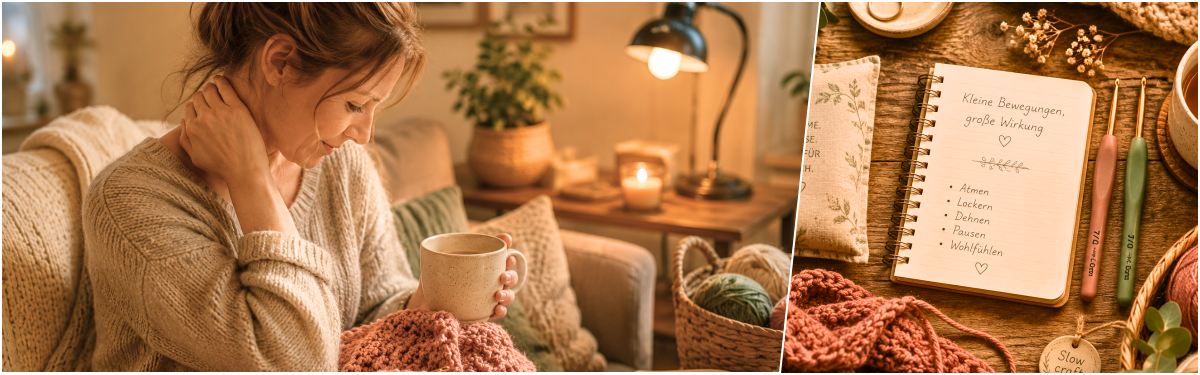
Why My Physiotherapist Regularly Scolds Me 😄
Whenever my best friend comes over for coffee these days, things almost always follow the exact same pattern.
She walks through the door, takes one look at me – and immediately rolls her eyes.
Not because of the coffee.
Not because of the yarn chaos all over the table.
But because of my posture.
Because of course I’m still “just quickly” working on some project while drinking my coffee.
With my shoulders pulled up.
My back hunched over.
My head pushed forward.
And usually after sitting in exactly the same position for several hours.
By the second cup of coffee, I usually start complaining:
“My neck is killing me.”
“My lower back is completely stiff.”
“I think I’ve permanently destroyed my hands.”
… while rubbing my fingers after eight straight hours of knitting.
My friend is a physiotherapist.
And in moments like these, she always looks at me as if I’m a particularly difficult patient.
At some point, she dryly said:
“Kathrin, your neck is working harder than your needles these days.” – and yes, that’s an actual quote.
And honestly?
She probably wasn’t wrong.
Because as relaxing as knitting and crochet can be, our bodies sometimes see things very differently.
Especially when we:
- sit in the same position for hours,
- constantly lift our shoulders,
- skip breaks,
- work in poor lighting,
- or crochet and knit with tense hands.
And since I’m obviously not the only person who sounds like an old wooden door while getting up after a creative marathon, she eventually put together a little personal “emergency survival kit” for me.
Including:
- simple loosening exercises,
- posture tips,
- small movement routines,
- little ergonomic tricks,
- and surprisingly simple everyday changes.
And the best part?
Most of these things take less than two minutes – but make a huge difference.
And honestly, the thought of other knitters and crocheters somewhere out there doing the exact same little exercises now kind of makes me smile – probably with a half-finished project on their lap and a cup of coffee or tea sitting beside them too.
So today, I’d love to share this little “handcraft survival kit” with you.
Why We Often Notice Crafting-Related Pain Too Late
The more we enjoy a project, the worse our sense of time sometimes seems to become.
“Just one more row.”
“Let me quickly finish this section.”
“Just one more turn.”
… and suddenly three hours have passed.
And that’s the strange part:
While we’re deeply focused on our work, we often completely ignore how long we’ve actually been sitting there without moving.
Without even noticing it, many of us tense up our:
- shoulders,
- hands,
- back,
- or constantly push the head forward.
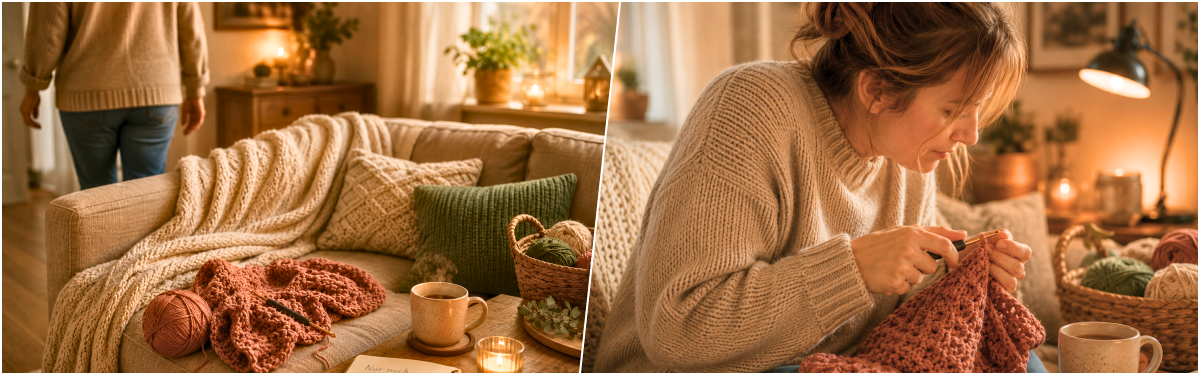
And because knitting and crochet can feel incredibly relaxing at the same time, we often don’t realise until much later just how tired or tense our body has actually become.
That’s exactly why I’ve started trying to see little movement breaks not as an “interruption,” but as part of my creative routine.
Because at some point I realised something very simple:
Creativity is a lot more enjoyable when your body isn’t completely offended by the end of the day.
Small Movements That Make a Big Difference
A long time ago, my friend told me something that honestly stuck with me:
“You don’t need to do an hour of back exercises every single day. But your body does need little reminders that it’s still allowed to move.”
And that’s exactly what the following exercises are about.
Not performance.
Not perfect workouts.
Not athletic achievements somewhere between yarn baskets and stitch markers.
But small, mindful movements that can genuinely help relieve tension in the neck, shoulders, back, and hands while knitting and crocheting.
Most of these exercises can easily be done:
- right at your workspace,
- on the sofa,
- sitting or standing,
- and often even in the middle of a project.
The most important thing is:
🟢 move slowly
🟢 breathe calmly
🟢 avoid sudden movements
🟢 and always listen to your body
Because every body is different.
What feels pleasant and relaxing for one person might feel uncomfortable or tiring for someone else. That’s exactly why every exercise should only ever be done as far as it genuinely feels good.
Of course, things like mobility, health conditions, personal limitations, and individual needs also play a role. Not every exercise works for every person – and that’s completely okay.
Because in the end, crafting isn’t about functioning perfectly.
It’s about doing something kind for yourself.
Many of these little exercises take less than two minutes – but they can still make a surprisingly big difference, especially during long creative evenings or extended knitting and crochet sessions.
5 Small Exercises for a More Relaxed Neck
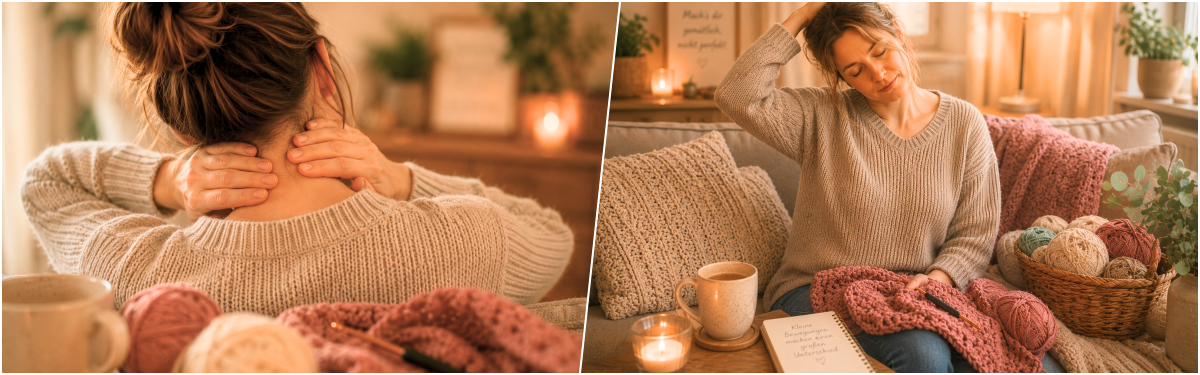
1. The Gentle Side Stretch
This exercise is especially helpful for tight neck muscles after long knitting or crochet evenings spent leaning forward over a project.
How to do it:
Sit comfortably in an upright position or stand in a relaxed posture. Let both shoulders consciously drop and relax your arms.
Now slowly tilt your head toward your right shoulder without lifting the shoulder itself. The movement should stay calm and gentle. You should feel a pleasant stretch along the left side of your neck – never a sharp pain.
⭐ Hold the position for about 15–20 seconds while breathing calmly.
Then slowly return to the centre and repeat on the other side.
Honestly, I was quite surprised when I first realised just how tense my neck actually was…
2. Releasing & Rolling the Shoulders
This little movement can work wonders when your shoulders slowly start creeping toward your ears after long crafting sessions 😄
How to do it:
Slowly lift both shoulders upward, roll them backward, and then let them gently drop back down.
The movement should feel large and flowing – almost as if you were drawing circles with your shoulders.
⭐ Around 8–10 slow repetitions are often enough.
I especially love this exercise in the middle of long rows or after particularly focused pattern sections.
3. Chin-to-Chest Stretch
This exercise helps relieve tension in the muscles at the back of the neck.
How to do it:
Slowly lower your chin toward your chest without pulling your shoulders forward.
Simply let your head hang naturally and hold the position for around 15–20 seconds.
If you’d like, you can gently place your hands on the back of your head – but without applying pressure. The natural weight of your hands is completely enough.
⭐ Important: never pull or force the stretch.
Especially after long days spent crafting or working at a screen, this exercise can feel incredibly soothing.
4. Slow “No” Turns
This gentle exercise improves mobility in the upper neck area and helps reduce that typical stiff feeling.
How to do it:
Slowly turn your head to the right, as if casually looking over your shoulder.
Hold the position briefly.
Then slowly move to the other side.
⭐ Around 5 calm repetitions per side are usually enough.
The movement should always stay slow and controlled – never jerky or forced.
5. The Conscious Change of Focus
This exercise sounds simple, but it makes a surprisingly big difference.
When we knit or crochet, we often stare downward at the same small area for long periods of time. That doesn’t just strain the neck – it also affects the eyes and shoulders.
How to do it:
Consciously lift your gaze away from your project and focus on something farther away in the room or outside the window for a few seconds.
Take a deep breath and intentionally relax your shoulders while doing so.
⭐ Repeat several times.
My friend lovingly calls this one:
“Briefly reminding your neck that the world is bigger than the current row.” 😄
By the way, neck and shoulders almost always work together as a little team when we knit or crochet.
The moment we become tense, sit in a highly focused position, or unconsciously pull our shoulders upward, the entire upper back area often starts tightening as well.
That’s exactly why small shoulder-relaxation exercises don’t just help reduce tension – they also make crafting overall feel noticeably more comfortable and relaxed.
5 Small Exercises for More Relaxed Shoulders
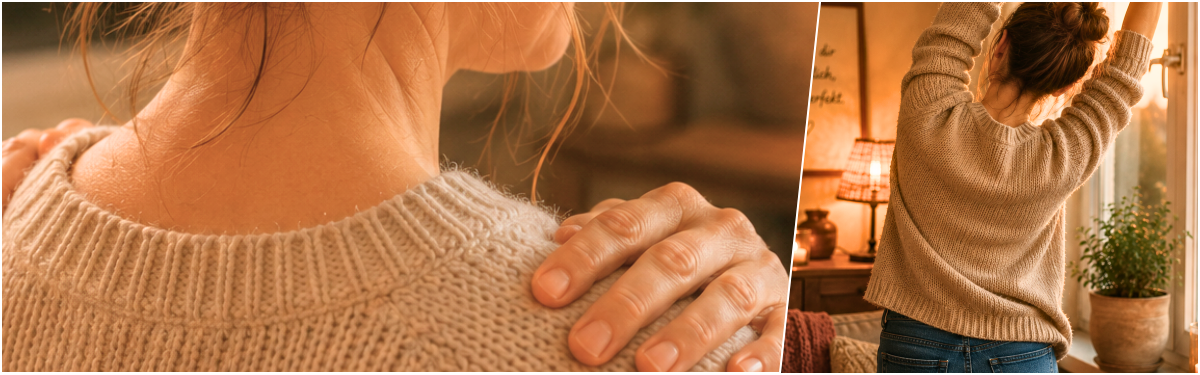
1. The “Chest Opening” Stretch
When we knit or crochet, we often spend hours sitting slightly hunched forward. Over time, this doesn’t just tense the shoulders – the chest area also gradually becomes tighter.
This simple exercise helps gently reopen the front of the body and relieve tension in the shoulders.
How to do it:
Sit upright or stand in a relaxed position. Clasp your hands loosely behind your back or simply hold onto your fingers gently.
Now slowly pull your shoulders down and back while slightly opening the chest. Keep your gaze relaxed and facing forward.
⭐ Hold the position for around 15–20 seconds while breathing calmly.
Important:
Avoid arching the lower back too much, and never force the shoulders backward. The movement should always feel gentle and comfortable.
Honestly, this exercise often feels surprisingly freeing.
2. Slowly Stretching the Arms Overhead
This gentle movement relaxes the shoulders, upper back, and chest area all at once.
How to do it:
Slowly raise both arms overhead, almost as if you’re giving yourself a proper stretch after finishing a long row.
Keep the shoulders relaxed and avoid actively pulling them upward.
⭐ Hold the position for a few seconds while breathing calmly.
If you’d like, you can also gently lean from side to side to softly stretch the muscles along the sides of the body.
3. Consciously Pulling the Shoulder Blades Together
This exercise is especially helpful against that typical “collapsed forward” posture that often happens during focused crafting sessions.
How to do it:
Sit upright and slowly pull your shoulder blades backward together – almost as if you were trying to hold a small pencil between them.
⭐ Hold briefly, then slowly relax again.
Around 8–10 repetitions are completely enough.
The movement should stay calm and controlled.
4. Lifting & Releasing the Shoulders
We often don’t even notice how much tension we unconsciously build up in our shoulders while knitting or crocheting.
How to do it:
Slowly lift both shoulders toward your ears and hold the tension for about 2–3 seconds while inhaling and briefly holding your breath.
Then consciously let the shoulders drop and exhale.
⭐ Around 8–10 calm repetitions can already help release a surprising amount of built-up tension.
Especially during difficult pattern sections or long periods of concentration, this little movement can feel incredibly soothing.
5. Gentle Shaking Out
It sounds simple – but it’s surprisingly easy to forget.
How to do it:
Put your project down for a moment and gently shake out both arms and shoulders.
Take a deep breath and consciously try to release tension from your arms and shoulders.
⭐ Even 20–30 seconds can already make a noticeable difference.
Especially after many rows, this is often the moment when you suddenly realise just how tense you’ve actually been working.
Tense shoulders rarely stay isolated during knitting and crochet 😄
Very often, that tension slowly spreads into the upper back, the lower back, or the entire lumbar area.
Especially long periods of sitting, deep concentration, and those famous “I’ll just finish this one last row” moments eventually make our back join the conversation quite loudly.
So now let’s look at a few small exercises that can give the back and lower spine a little more movement, relief, and relaxation in between crafting sessions.
5 Small Exercises for Your Back & Lower Spine
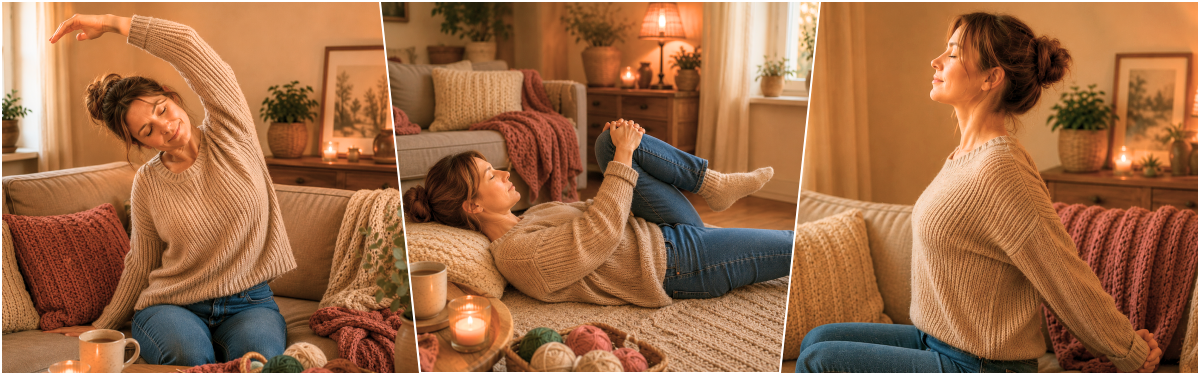
1. The Gentle Seated Cat Stretch
This exercise helps mobilise the spine and is especially helpful when your back feels stiff or tight after sitting for a long time.
How to do it:
Sit upright on a chair or on the edge of the sofa with both feet firmly placed on the floor.
As you exhale, slowly round your back and gently pull your shoulders slightly forward – almost like a cat arching its back.
As you inhale, slowly straighten back up and move into a very gentle back arch without exaggerating the movement.
⭐ Repeat the movement calmly 8–10 times.
Important:
The motion should stay smooth and comfortable, never painful.
2. Knee-to-Chest Stretch
This exercise is especially soothing for the lower back and lumbar area.
How to do it:
Lie comfortably on your back or lean back in a relaxed seated position if that feels better for you.
Slowly pull one knee toward your chest and hold it gently with both hands.
⭐ Hold for about 15–20 seconds while breathing calmly, then switch sides.
If you’d like, you can also pull both knees toward your chest afterward.
The stretch should feel pleasant – never painful or forceful.
3. Pelvic Tilts for the Lower Back
A small but surprisingly effective exercise for releasing tension in the lower back.
How to do it:
Sit upright or lie comfortably on your back.
Now slowly tilt your pelvis slightly forward and then backward again – almost as if you were gently bringing movement into the lower spine.
⭐ Repeat the movement slowly 10–15 times.
People who sit for long periods often only realise during this exercise just how stiff the lower back has actually become.
4. Side Stretch for Back & Waist
This exercise loosens the muscles along the sides of the torso and helps relieve the lower back.
How to do it:
Sit upright or stand in a relaxed position.
Slowly raise one arm overhead and gently lean your upper body toward the opposite side.
⭐ Hold for around 15 seconds, then switch sides.
The movement should stay soft and comfortable – never forced, jerky, or bouncy.
5. Standing Up & Walking Mindfully
It sounds almost too simple – but many of us completely underestimate it.
How to do it:
Consciously stand up, walk a few steps through the room, and gently roll your shoulders and back as you move.
⭐ Even just 1–2 minutes of movement can noticeably relieve the back.
Honestly, the human body was never really designed to stay frozen over the same stitch for four straight hours 😄
While neck, shoulders, and back usually complain quite loudly, our hands often try to keep going surprisingly bravely for a very long time.
And honestly, they do an incredible amount of work while we knit and crochet:
gripping, holding, guiding, controlling tension, repeating the same movements over and over again – often for hours at a time.
Especially fine yarns, tight stitches, or long creative sessions can eventually lead to tired fingers, tense hands, or irritated wrists.
So next, let’s look at a few small exercises that can help loosen and relieve the hands, fingers, and wrists in between crafting sessions.
5 Small Exercises for Hands, Fingers & Wrists
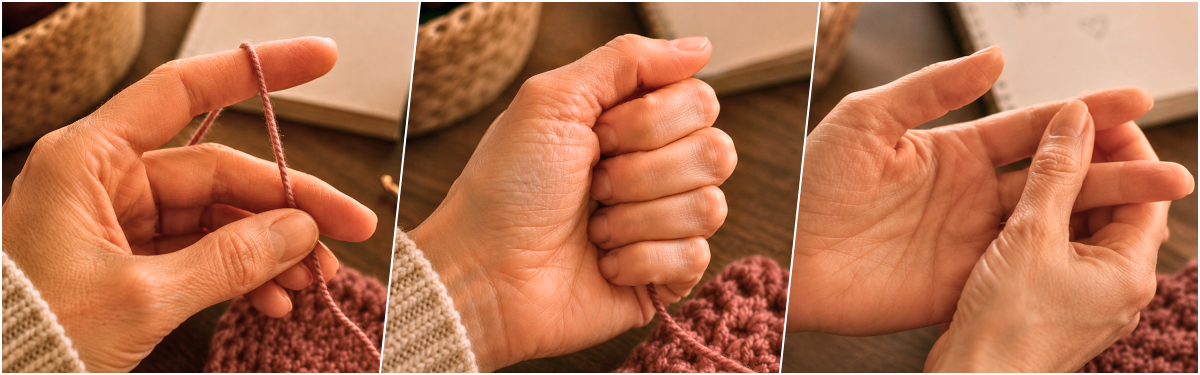
1. Opening & Closing the Fingers
This exercise is a great starting point when your hands feel stiff after long knitting or crochet sessions.
How to do it:
Hold both hands loosely in front of you. Open your fingers wide without tensing them, then slowly close them into a soft, relaxed fist.
⭐ Repeat 8–10 times.
Important: Don’t squeeze the fist tightly. This isn’t about strength – it’s about gentle, mindful movement.
2. Tendon Gliding for the Fingers
This exercise is commonly used in hand therapy to support finger mobility by moving the fingers through different positions.
How to do it:
Start with a straight hand and fully extended fingers.
Then move through the following positions one after another:
- Bend the fingers into a hook shape
- Straighten them again
- Close the fingers into a loose fist
- Straighten them again
- Bend the fingers into a flat fist so the fingertips point toward the wrist
⭐ Hold each position briefly, then slowly release. Around 3–5 rounds are completely enough.
It sounds more complicated than it actually is – after a few repetitions, it almost feels like a little workout routine for your fingers.
3. Thumb-to-Fingertip Touches
The thumb works constantly while knitting and crocheting: holding, guiding, stabilising – and usually getting far too little attention.
How to do it:
Touch the tip of each finger with your thumb one after another:
index finger, middle finger, ring finger, little finger.
Then move back again.
⭐ About 5 slow rounds per hand are enough.
The movement should stay soft and relaxed. If your thumb feels tired, simply do fewer repetitions.
4. Gentle Wrist Stretch
Especially during tight crochet work or long knitting sessions, the wrists and forearms do a surprising amount of work. Gentle wrist stretches are also commonly recommended in orthopaedic exercise programmes.
How to do it:
Stretch one arm comfortably forward with the palm facing downward.
Gently bend the wrist so the fingers point toward the floor. With the other hand, carefully assist the movement until you feel a light stretch in the forearm.
⭐ Hold for around 10–15 seconds, then switch sides.
After that, stretch the arms forward again – this time with the palms facing upward.
And then repeat the same movement once more.
Important: Stretch gently only. No pulling, no forcing, no “something has to crack loose now.”
5. Shaking Out & Consciously Relaxing the Hands
It almost sounds too simple – but it’s one of the best little reset breaks in between.
How to do it:
Put your project aside for a moment and gently shake out your hands and fingers.
Then consciously relax your hands completely: let the fingers hang loosely, release the shoulders, and take a deep breath.
⭐ Even 20–30 seconds can already help a lot.
Especially after tight stitches, small crochet hooks, or long rows, this is often the moment when you suddenly realise just how tense your hands actually were.
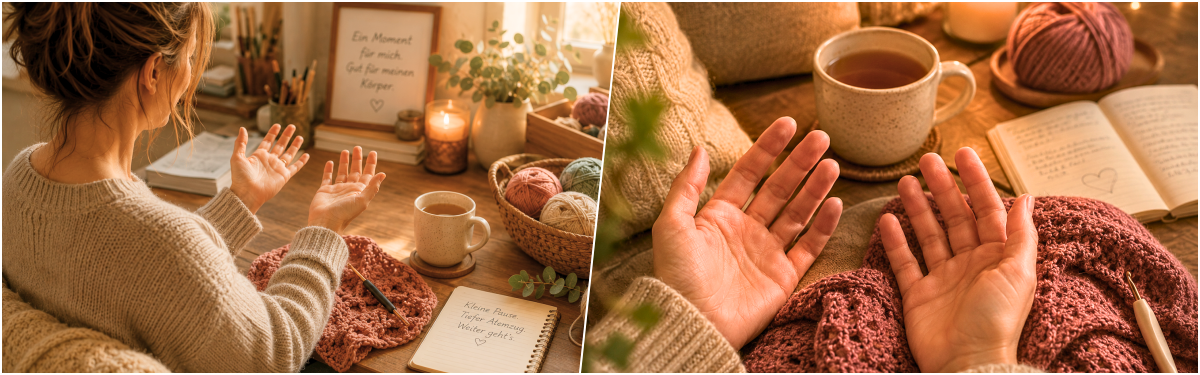
At some point, I simply started weaving these little exercises naturally into my creative routine – not perfectly, not with military precision, but just here and there throughout the day.
Because often, just a few minutes of movement are enough to make the neck, shoulders, back, and hands feel noticeably more relaxed by the end of the evening.
And what I find most relaxing about it?
You don’t need a gym membership or suddenly become a yoga master to do it.
Most of these little movements can easily fit in between two rows, after finishing a pattern section, or during a short coffee break.
And honestly, these days it’s not just my back and hands benefiting from it – Emma and Muki do too.
Because the moment I start the famous “standing up exercise,” the two of them usually know immediately:
👉 Time for a little walk 🐕🦺
Altogether, this little “stitch-balance routine” often takes no more than 10–15 minutes – especially when you simply spread the exercises throughout the day.
And for me personally, this order has worked particularly well:
➡️ first the neck
➡️ then the shoulders
➡️ followed by the back & lower spine
➡️ and finally the hands & fingers
That way, the body gradually loosens up again from top to bottom – and only afterward do you often realise just how much tension you were carrying around the entire time.
Small Changes That Make a Surprisingly Big Difference
As helpful as these little exercises can be, sometimes it’s actually the small, almost invisible everyday habits that make the biggest long-term difference when it comes to knitting and crochet.
Because many physical complaints don’t appear suddenly – they slowly sneak up on us over time.
And at this point, it’s really more about prevention.
Ever since I started paying more attention to these little details alongside my movement routine, long creative days have become noticeably more comfortable.
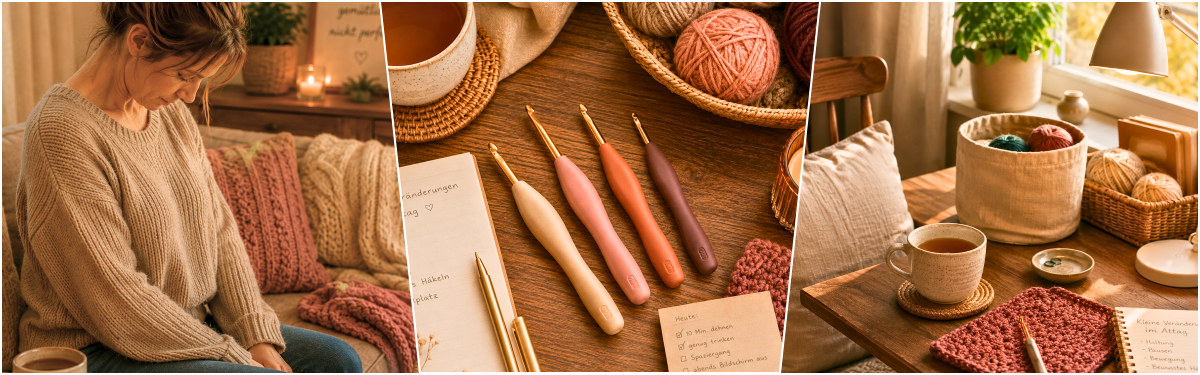
What has helped me most:
- a small cushion behind the lower back
- good lighting in the evening
- consciously holding yarn and needles more loosely instead of “death-gripping” them
- standing up regularly
- drinking enough water
- and taking small mini-breaks between larger pattern sections
Lighting, especially, was something I completely underestimated for years.
Because the moment we struggle to see properly or constantly work against shadows, the entire body automatically starts tensing up more and more.
Even sitting posture makes a surprisingly big difference.
These days, I pay much more attention to:
- keeping both feet on the floor,
- not crossing my legs,
- relaxing my shoulders,
- and not permanently holding projects deep in my lap, but occasionally working at a table instead.
Especially while crocheting, I notice immediately when I start working too tensely or gripping the hook far too tightly.
Other things that can also make a noticeable difference:
🟢 ergonomic knitting needles or crochet hooks
🟢 softer grips
🟢 lighter needles
🟢 or small crafting cushions to support the arms
Especially during long projects or for sensitive hands, these little adjustments can significantly reduce pressure on the fingers and wrists.
Because as much as we love our projects – our body is sitting at the table for every single stitch right alongside us.
#FunFact from Everyday Crafting Life
To finish things off, here’s something that many dedicated knitters and crocheters will probably recognise – although this time it’s less about posture or ergonomics and more about the little “surface-level battle scars” of creative life 😄
Because eventually, it’s not just the neck, back, or shoulders that start complaining – sometimes our fingers decide they’ve had enough too.
Especially with:
- tight stitches,
- long crafting sessions,
- rougher yarns,
- intricate lace patterns,
- or very fine needles…
you can end up with small pressure marks or even proper blisters exactly where the yarn or needle constantly rubs against the skin.
And at some point, I think every crafter develops their own very personal “problem areas.”
The exercises really do help a lot with tension and overuse – but unfortunately, they can’t win against every little friction spot.
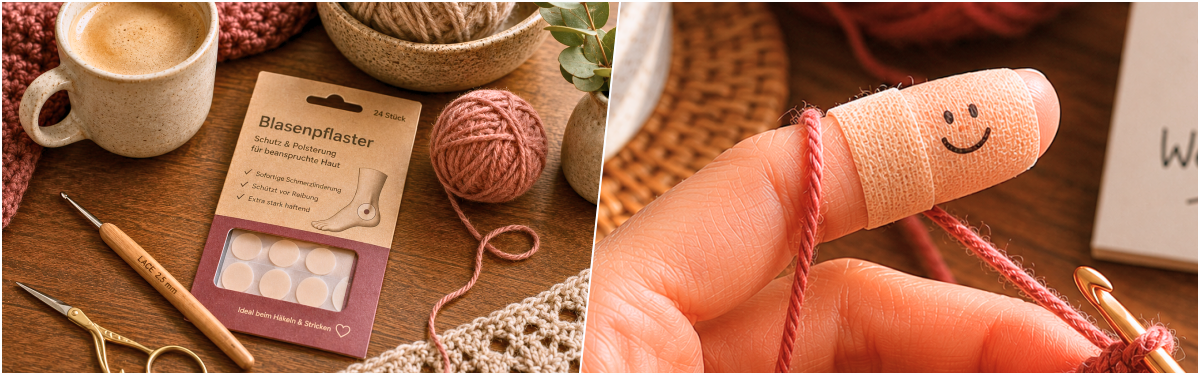
So what’s my personal little secret weapon?
Blister plasters 😄
And preferably before the damage happens – not afterward.
I usually cut them in half and stick them onto the areas that tend to get irritated before longer knitting or crochet sessions.
They stay in place surprisingly well, add a nice bit of cushioning, and honestly, they’ve already saved quite a few long creative evenings for me.
Conclusion: Between Stitches, Creativity & Small Movement Breaks
The longer I knit and crochet, the more I realise that creative work isn’t just about ideas, yarn, and projects – it’s also about how we treat our own bodies while doing it.
And honestly?
I used to ignore a lot of discomfort.
Neck pain? - “I’m fine.”
Tense shoulders? - “Just one more row.”
Tired hands? - “This project has to be finished today.”
These days, I see things much more calmly.
Not perfectly.
Not always as a shining example 😄
But definitely more consciously.
Because small exercises, short breaks, and simply paying a little more attention to our bodies can make a surprisingly big difference in everyday creative life.
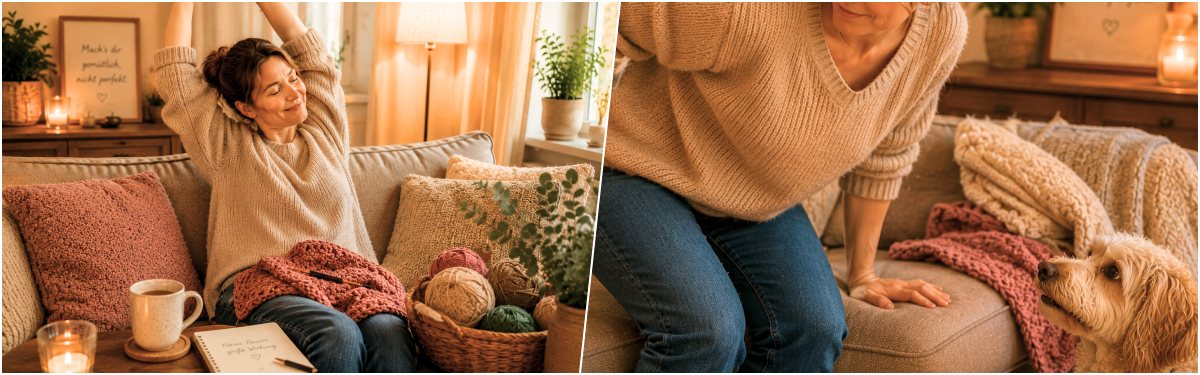
And maybe that’s what it’s really about in the end:
That crafting doesn’t just create beautiful projects – but also becomes something that fits a little more gently into our lives and into the way we treat ourselves.
With less pressure.
More movement.
More ease.
And maybe also with a little more care for our neck, back, shoulders, and hands.
Because as much as we love our projects – our body is working along with every single stitch.
Sometimes knitting and crochet aren’t just about stitches, projects, or finished pieces – they’re also about how we treat ourselves along the way.
🧶 What do you think about this topic?
Have you ever noticed how much your neck, shoulders, back, or hands “join the project” during long crafting sessions?
Or maybe you’ve developed your own little routines, stretches, or tricks that make long creative evenings feel more comfortable? – I’d truly love to hear your experiences, ideas, and thoughts in the comments.
📸 Maybe you’ll even try some of these exercises yourself or start adding small movement breaks more consciously into your creative routine?
If you do, definitely tell me about it – or feel free to share your knitting or crochet space as well. I always love seeing how differently everyone creates their own cosy crafting atmosphere.
✨ And of course, if you enjoy my articles, I’d be incredibly happy if you followed me here on CrazyPatterns so you won’t miss any new articles, ideas, or patterns.
.png)
🧡 Maybe you’ll also discover a few more articles in my CrazyPatterns blog – or perhaps find a pattern in my shop that inspires your next creative project.
All my love,
Kathrin with Emma & Muki
Photos, designs & content © Kathrin | stricken-im-trend.com


