I’ll be honest:
When crocheted dish scrubbies, textured cleaning cloths, and sustainable household helpers suddenly started popping up everywhere, I was skeptical at first.
Of course, I understood the idea behind it.
Reusable instead of disposable, less waste, more sustainable everyday routines — all of that makes perfect sense.
Still, for a long time, I felt that many of these projects were designed mainly with function in mind.
Practical? Absolutely.
Especially beautiful? Not really.
And that’s exactly when a completely different question started to interest me:
What happens when you take this type of yarn out of the traditional kitchen-and-household context?
What if bubble yarn suddenly no longer looks like something meant for the sink, but instead feels like spa decor, selfcare, soft bathroom aesthetics, and calm natural tones?
That was exactly what I wanted to explore.
I never expected it to turn into an entire little bathroom collection.
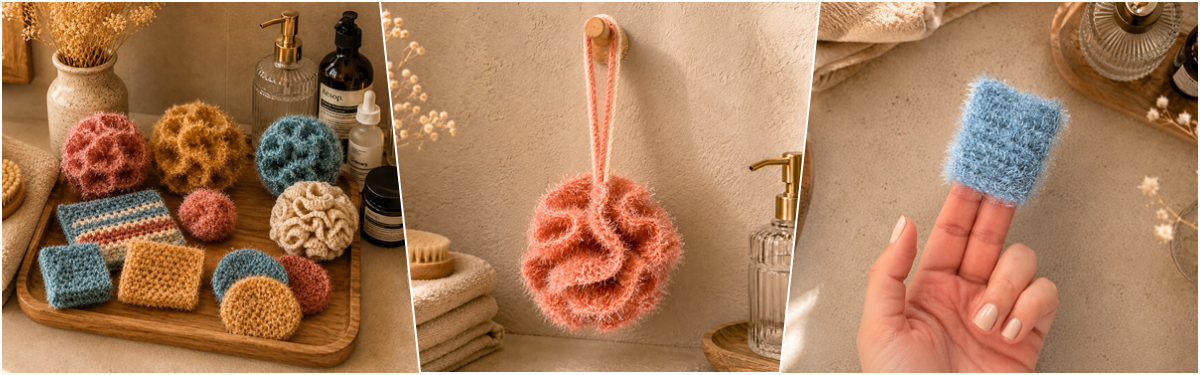
Because these days, I actually use my crocheted sponges and skincare pads every single day — not just because they look beautiful, but because different yarns create completely different textures and experiences.
What surprised me most was the direct comparison between classic cotton yarn and textured bubble yarn.
Same pattern.
Same shape.
Same basic idea.
And yet suddenly, the finished piece feels completely different in your hands.
And that’s exactly what I want to talk about today.
When Yarn Suddenly Changes the Entire Mood
One of the most fascinating things about crochet and knitting often isn’t the technique itself — it’s the material.
Because sometimes, the overall feeling of a project isn’t defined by the pattern at all, but entirely by the yarn you choose.
And that was exactly what I noticed while working on these bathroom accessories.
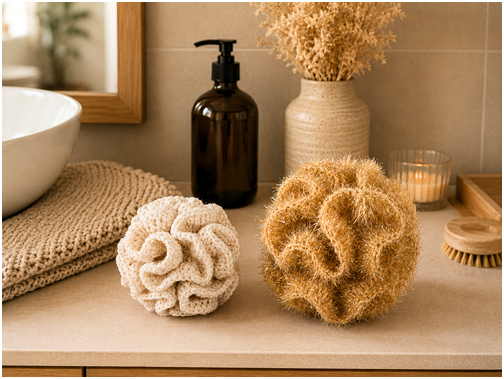
The cotton version immediately felt calmer, softer, and almost slightly minimalist.
Gentle, comfortable, understated.
Almost like a small wellness accessory you’d find in a quiet spa hotel.
The bubble yarn version, on the other hand, instantly added more texture.
More volume.
More grip.
More of that unmistakable “bathroom spa” feeling.
And that’s exactly when the whole topic suddenly became interesting to me.
Because textured or scrubby yarns are usually associated with the same kinds of projects:
- dish scrubbies
- cleaning cloths
- kitchen helpers
- household crochet projects
But in a bathroom setting, the effect suddenly changes completely.
The yarn no longer feels purely functional — instead, it starts to look modern, cozy, and surprisingly luxurious, especially when combined with neutral colors, cotton, wood, linen, or calm natural bathroom aesthetics.
And maybe that’s exactly why these small handmade projects are becoming more and more popular right now.
They combine function with atmosphere.
And somehow, that combination makes them far more interesting than they first appear.
Bathroom Accessories Are Quietly Making a Comeback
If you spend any time on Pinterest, Instagram, or in handmade communities right now, one thing quickly becomes obvious:
Bathroom aesthetics are changing.
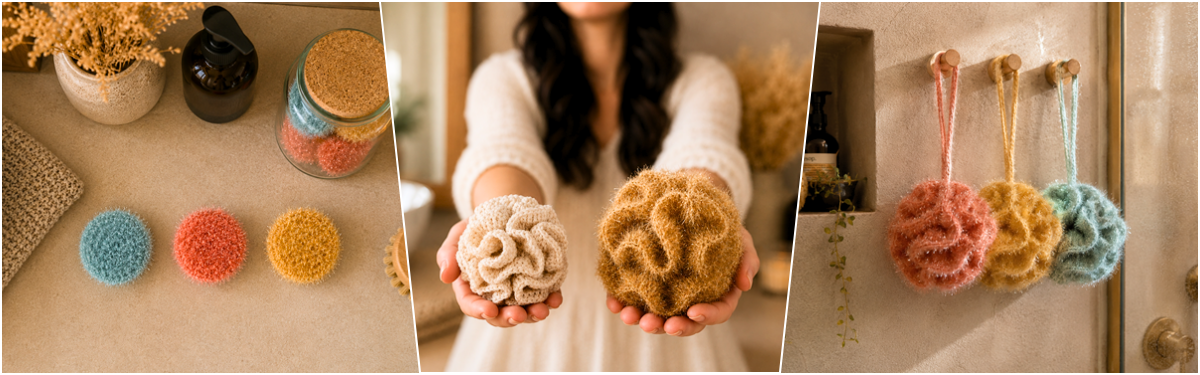
More and more people are trying to turn everyday routines into small moments of calm.
Less plastic.
Less loud packaging.
Less disposable culture.
Instead, there’s a growing focus on natural materials, soft colors, and intentionally chosen everyday items.
And somehow, crocheted bathroom accessories fit surprisingly well into that world.
Not as old-fashioned “grandma decor,” but as part of a slower, more mindful lifestyle.
Especially projects like:
- reusable face pads
- luffa-style crochet sponges
- washcloths
- back scrubbers
- soap saver bags
all have one major advantage:
They’re quick to make, immediately useful, and genuinely practical in everyday life.
And I think that’s exactly what makes them so appealing.
Because many sustainable lifestyle changes fail the moment they become too complicated.
Small handmade projects, on the other hand, are easy to integrate into daily routines almost instantly.
Maybe that’s exactly why these ideas resonate with so many people right now.
Because in the end, it’s often these tiny everyday projects that quietly change more than just a bathroom shelf.
While working on my first luffa sponges and textured spa-inspired crochet projects, I suddenly found myself thinking about an older article I had written some time ago.
The longer I worked with these organic shapes, textured yarns, and soft rounded forms, the more some of the surfaces started to remind me of textile coral pieces or tiny underwater landscapes.
And eventually, that’s exactly where the name came from:
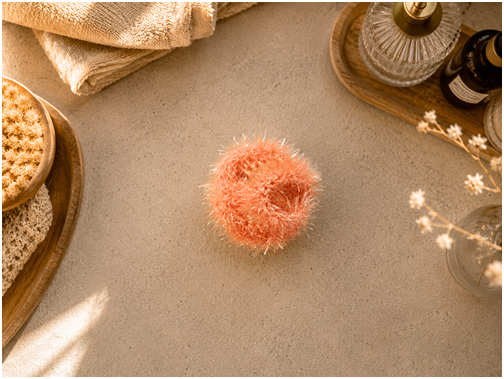
Coral Spa Collection
Interestingly enough, the connection between crochet and coral worlds isn’t actually as far-fetched as it may sound.
Because at that moment, I was reminded of a project that had fascinated me for years.
Fun Fact
Around the world, several art and environmental projects have explored the idea of crocheted coral reefs as a way to raise awareness about coral bleaching and endangered marine ecosystems.
One of the most famous examples is the international Crochet Coral Reef Project, created by sisters Margaret and Christine Wertheim together with the Institute For Figuring.
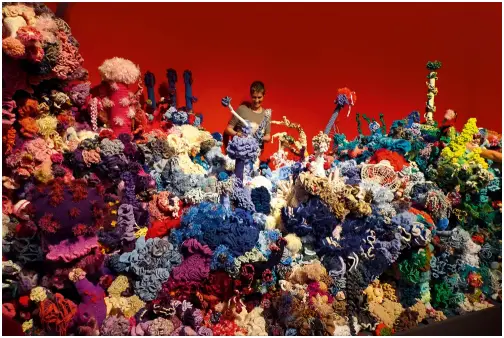
Source & inspiration: The Crochet Coral Reef Project by Margaret and Christine Wertheim
Since then, enormous textile underwater landscapes have been created from wool, cotton, synthetic yarns, and all kinds of unexpected materials.
Thousands of people participated by crocheting coral-inspired forms, reef-like textures, sponge structures, and organic surfaces together.
And honestly, that’s exactly what makes the whole idea so fascinating:
Many of these shapes can actually be recreated surprisingly well with crochet techniques.
Because corals and marine organisms often feature repeating organic structures that look remarkably similar to crochet textures and stitch patterns.
Especially:
- spirals
- increases
- textured stitches
- relief stitches
- structured yarns
can create surfaces that sometimes look astonishingly close to real coral formations.
And maybe that’s exactly why these little spa-inspired crochet projects started reminding me so strongly of underwater worlds.
And somehow, I really love that idea:
That a simple ball of yarn can suddenly turn into something that feels connected to nature, water, movement, and organic forms.
At the same time, this direct comparison between different yarns also shows just how dramatically materials can change the entire mood and character of a project.
Cotton vs. Bubble Yarn — Same Pattern, Completely Different Result
One of the most fascinating parts for me was the direct comparison between the two materials.
Because technically, the exact same crochet pattern can look and feel completely different simply depending on the yarn you use.
And honestly, that’s one of the things I love most about crochet and handmade projects in general.
The Cotton Version
Cotton feels calmer, softer, and more natural overall.
Especially for reusable face pads or gentler skincare accessories, I personally find cotton incredibly pleasant to use.
It absorbs moisture well, feels soft against the skin, and creates a cleaner, calmer overall aesthetic.
I especially love cotton in:
- natural shades
- cream tones
- beige
- sandy neutrals
- warm earthy colors
Those tones instantly create a quiet spa-like atmosphere.
Cotton is also pleasantly low-maintenance and durable — as long as you choose the right quality yarn.
Bubble Yarn & Textured Yarns
Bubble yarns and textured scrubby yarns, on the other hand, create a completely different effect.
The finished project becomes more textured, more airy, more dimensional, and often slightly more voluminous.
The sponge feels more exfoliating and massage-like, almost closer to classic spa or peeling products.
And honestly, that surprised me.
Because originally, I would never have associated this type of yarn with bathroom accessories at all.
But in a bathroom or selfcare setting, it suddenly works incredibly well.
Especially for:
- shower accessories
- body care
- textured cleansing
- massage effects
- larger bath sponges
- facial care
- makeup removal routines
I find bubble yarn surprisingly exciting to work with.
Because it doesn’t just change the texture of a project — it changes the entire feeling and atmosphere of it.
Which Cotton Yarn Actually Works Best?
When it comes to bathroom accessories, one thing becomes clear very quickly:
The choice of yarn matters far more than most people initially expect.
Because projects like these aren’t just about appearance — they also need to handle:
- frequent washing
- constant moisture
- direct skin contact
- durability
- everyday hygiene
And that’s exactly why not every cotton yarn automatically works equally well.
Bathroom projects are used constantly, get wet repeatedly, dry again, and need regular washing.
So the yarn has to withstand much more stress than many traditional fashion or home decor crochet projects.
What I Personally Look For Now
For bathroom and spa-inspired crochet projects, I now mainly prefer:
- sturdy 100% cotton yarn
- mercerized cotton
- kitchen cotton yarns
- OEKO-TEX certified yarns
- cotton qualities that hold their shape well
The most important thing for me is that the yarn can handle frequent washing without problems.
Because bathroom accessories are constantly being used, getting wet, drying again, and being washed repeatedly.
That means the material has to withstand much more wear and tear than many typical fashion or home decor crochet projects.
Very soft fashion cottons may feel beautiful at first, but they sometimes lose their shape more quickly or take much longer to dry.
More durable cotton qualities often perform much better here — especially in the long run.
Care & Washability — What Really Matters
When it comes to bathroom accessories, washability has honestly become almost more important to me than perfect aesthetics.
Because these projects shouldn’t just look beautiful — they also need to work well in everyday life.
That’s why I prefer yarns that can handle regular washing without problems — ideally even at 60 °C / 140 °F.
What matters most to me is:
- shape retention
- absorbency
- durability
- easy everyday care
Because moisture, warmth, and daily use are simply part of any bathroom environment.
And especially with crocheted bathroom accessories, people often underestimate how important proper care actually is.
Because even the prettiest yarn doesn’t help much if a sponge stays damp all the time or starts developing odors.
After Each Use
These days, I always let my crochet sponges dry as openly and airy as possible.
It sounds simple, but it honestly makes a huge difference.
The most important things are:
- squeeze out excess water well
- don’t leave them crumpled up
- allow plenty of airflow while drying
- avoid trapped moisture whenever possible
Thicker cotton yarns sometimes take a bit longer to dry than certain scrubby yarns.
Regular Cleaning
And honestly, the same principle applies here too:
I’d rather wash them regularly than keep using them for too long.
Depending on how often I use them, I wash my crochet sponges quite frequently — especially the facial care and bathroom versions.
What I personally pay attention to most:
- machine washable at 60 °C / 140 °F
- no fabric softener
- airy drying whenever possible
Why no fabric softener?
Because it often reduces absorbency quite noticeably.
And absorbency is actually one of the biggest advantages of cotton in the first place.
Dryer — Yes or No?
Classic cotton usually handles the dryer fairly well overall.
That said, very frequent high-heat drying can eventually affect the shape of crochet projects over time.
When it comes to textured bubble yarns or scrubby yarns, though, I’ve become a bit more careful.
Many of these yarns contain synthetic fibers like polyester. They’re durable and easy to care for, but they can sometimes react more sensitively to strong heat.
Especially the textured surface may gradually lose some of its structure or grip after repeated hot drying cycles.
That’s why I now prefer to air-dry many of my bathroom crochet projects whenever possible — especially the more textured pieces from my Coral Spa Collection.
It may take a little longer, but it preserves the texture, structure, and overall feel of the material much better.
When Should You Replace a Crochet Sponge?
Honestly, this is part of the topic too.
A sponge should definitely be replaced once it:
- develops a constant damp smell
- can no longer be cleaned properly
- becomes heavily stretched out
- loses its texture and structure
And that’s actually one of the reasons I love small handmade projects like these so much:
You can simply crochet a fresh new one whenever you need it.
Small Projects, Bigger Impact — The Sustainability Behind Them
Of course, a crocheted sponge isn’t going to change the world overnight.
But honestly, projects like these often make sustainable habits feel much more realistic and manageable in everyday life.
Because they’re:
- uncomplicated
- quick to make
- immediately useful
- reusable
- often longer-lasting than many disposable products
And that’s exactly what I like about them.
Not the idea of “perfect sustainability.”
Not the pressure to suddenly do everything the “right” way.
But simply the idea of using things more consciously and making everyday routines feel just a little more mindful and sustainable.
Using Yarn Scraps Instead of Letting Them Pile Up
I think every crocheter and knitter knows those tiny leftover balls of yarn.
Too nice to throw away.
Too small for a large project.
And somehow, they just keep accumulating.
And honestly, that’s exactly why I’ve started loving these small bathroom crochet projects so much.
Because often, all you really need are:
- small cotton leftovers
- half-used skeins
- little color experiments
- leftover bubble yarn
to create something genuinely useful.
And suddenly, even the smallest amounts of yarn have a real purpose again.
That’s exactly why crochet luffa sponges, washcloths, and reusable face pads work so perfectly as creative stash-busting projects.
A few leftover meters of yarn can suddenly turn into something you actually use every single day.
⭐ Try It Yourself: 5 Small Spa-Inspired Crochet Projects
Of course, I couldn’t write an article about this topic without including a few free crochet ideas as well.
From practical everyday helpers to calming spa-inspired selfcare projects, these designs combine handmade creativity, sustainability, and mindful bathroom routines in a simple and approachable way.
And who knows — maybe your next favorite crochet project is already waiting on your hook.
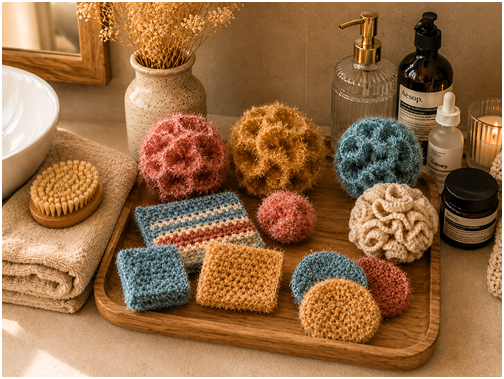
Materials for All Projects
The same basic materials were used for all of the spa-inspired and luffa-style crochet projects featured in this article.
Depending on the project size and the texture you want to achieve, the exact yarn amounts may vary slightly.
Yarns Used:
Bubble Yarn / Spa Yarn
RICO CREATIVE BUBBLE (50 g = 90 m / approx. 98 yds)
- Color No. 031: Natural — 50 g
- Color No. 033: Dusty Rose — 50 g
- Color No. 023: Blue/Mint — 50 g
- Color No. 030: Yellow/Gold — 50 g
Cotton Yarn
Elisa Apollo (50 g = 125 m / approx. 137 yds)
- Color No. 2600: Natural — 50 g
You will also need
- 3.00 mm crochet hook (US C/D)
- scissors
- tapestry needle
- optional: hanging loops, wooden beads, or labels
The exact adjustments and yarn amounts will always depend on the individual project.
Techniques & Basics
Depending on the pattern, the projects are worked either in rounds or in rows.
Abbreviations Used (UK Terms)
- ch = chain
- dc = double crochet (US sc – single crochet)
- htr = half treble crochet (US hdc – half double crochet)
- tr = treble crochet (US dc – double crochet)
- sl st = slip stitch
- tch = turning chain
- st/sts = stitch/stitches
- [ … ] = repeat the stitches inside the brackets continuously
General Notes
Working in Rounds
Start with either a magic ring or a chain joined into a round with a slip stitch, then continue working round by round as instructed.
Working in Rows
Begin with a foundation chain and crochet row by row as instructed.
Mesh Stitch Pattern for the Skincare Pads
The stitch pattern is worked over a multiple of:
2 + 1 + 1 tch
Basic Pattern: Extract from the Crochet Chart
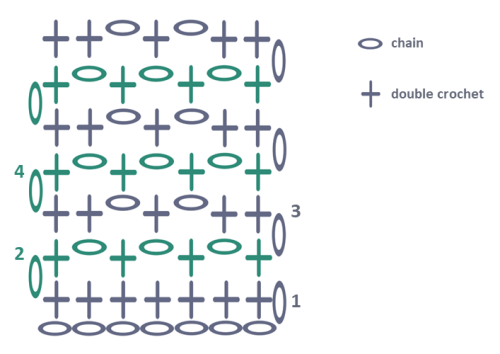
Basic Pattern: Row by Row
Row 1
ch 1 (tch),
work 1 dc into each ch across the foundation chain,
turn
Row 2
ch 1 (tch),
[ 1 dc, ch 1, skip 1 st ],
end with 1 dc, turn
Row 3
ch 1 (tch),
1 dc,
[ 1 dc, ch 1, skip 1 st ],
end with 2 dc, turn
Work Rows 1–3 once.
After that, continuously repeat Rows 2 and 3.
With the basic techniques covered, it’s time to start crocheting.
🧽 Reusable Face Pads
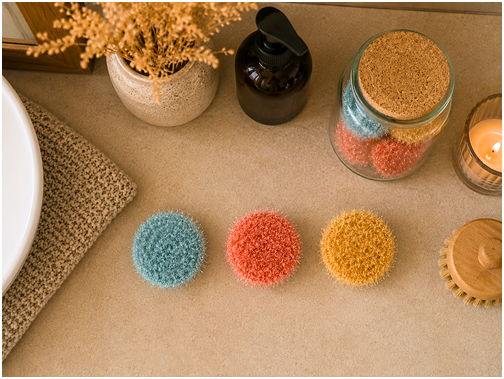
Honestly, I can never have enough of these little pads.
I keep them in a small pad container, so I always have several ready to use — especially because I regularly wash them inside a laundry bag with the rest of my towels and bathroom textiles.
You Will Need
- leftover scrubby yarn of your choice
- colors used: see material list above
Pad Sizes
- bubble yarn version: approx. 6 × 6 cm / 2.4 × 2.4 in
- cotton version: approx. 5.5 × 5.5 cm / 2.2 × 2.2 in
The pads are worked in rounds.
Instructions
Start with a magic ring or ch 4 and join with a sl st to form a ring.
Round 1
ch 1 (counts as the first dc),
work 7 dc into the ring and close the round with a sl st. (= 8 sts)
Round 2
The stitches are doubled:
ch 2 (counts as the first htr),
work 1 htr into the same stitch,
then work 2 htr into each dc from the previous round.
Close the round with a sl st. (= 16 sts)
Round 3
The stitches are doubled again:
ch 2 (counts as the first htr),
work 1 htr into the same stitch,
then work 2 htr into each htr from the previous round.
Close the round with a sl st. (= 32 sts)
And just like that, your first reusable face pad is finished.
Using bubble yarn creates a wonderfully textured makeup remover pad — honestly, that’s exactly how I use mine most often these days.
I also like using different colors to easily separate pads for eye makeup, facial cleansing, or general skincare routines.
With cotton yarn, on the other hand, the surface becomes noticeably softer and gentler against the skin.
🧽 Skincare Quartet – Eye, Face & Neck Care
For me, the real skincare routine actually begins after removing makeup.
Over time, this slowly turned into a small selfcare ritual of its own: I usually start with the little luffa sponge, then use my small “finger mitt,” followed by the skincare pad — first with the scrubby side, then with the cotton side — and finally, my neck gets its own little care routine as well.
And that’s exactly how this small skincare quartet for eyes, face, and neck eventually came to life.
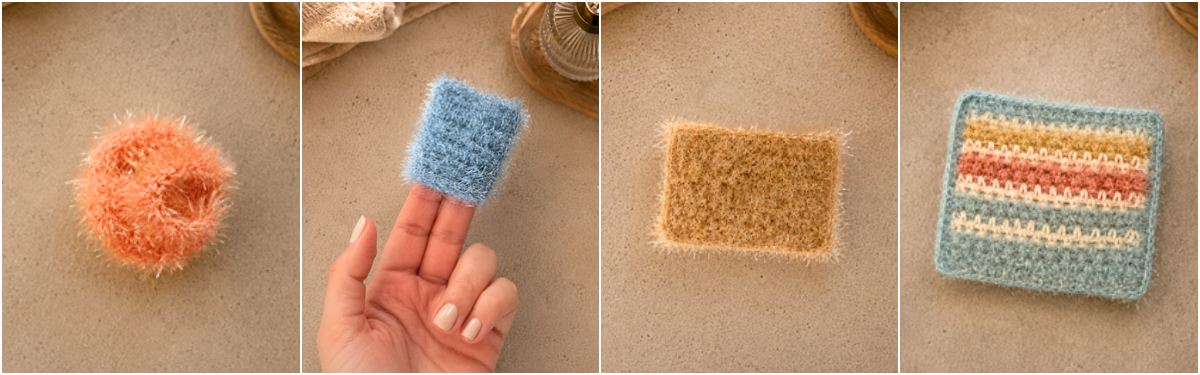
Materials for the Skincare Quartet
The same basic materials were used for all four skincare projects.
You will need:
- cotton yarn of your choice: approx. 20 g
- scrubby yarn of your choice: approx. 50 g
The colors used correspond to the material list in the section above.
🪸 Small Luffa Sponge for Everyday Cleansing
This little luffa sponge is usually the first step in my cleansing routine after removing makeup.
Especially when made with bubble yarn, it creates a pleasantly textured surface that almost feels like a gentle little spa exfoliator.
Size
approx. 7 × 7 cm / 2.8 × 2.8 in
The sponge is worked in rounds.
Start with cotton yarn first, then switch to scrubby yarn.
Instructions
Cutton Yarn
Start with a magic ring or ch 6 and join with a sl st to form a ring.
Round 1
ch 1 (counts as the first dc),
work 19 dc into the ring and close the round with a sl st. (= 20 sts)
Round 2
The stitches are increased fivefold:
ch 3 (counts as the first tr),
work 4 tr into the same stitch,
then work 5 tr into each dc from the previous round.
Close the round with a sl st. (= 100 sts)
Round 3
Now switch to scrubby yarn:
ch 3 (counts as the first tr),
work 1 tr into each tr from the previous round and close the round with a sl st. (= 100 sts)
Und schon ist dein erstes kleines Luffa-Schwämmchen fertig.
🪸 “Finger Mitt” Skincare Pad
Originally, I had planned this little “finger mitt” quite differently.
At first, I wanted to fill the pad with cotton stuffing, which is why I initially left one side open. But while crocheting, I suddenly realized how practical the small finger opening actually was — and that’s exactly why I decided to keep the idea.
It also became obvious pretty quickly that the double-layered construction didn’t need any additional filling at all.
And honestly, I personally find it more hygienic that way too — because fillings can always become a bit tricky in bathroom projects.
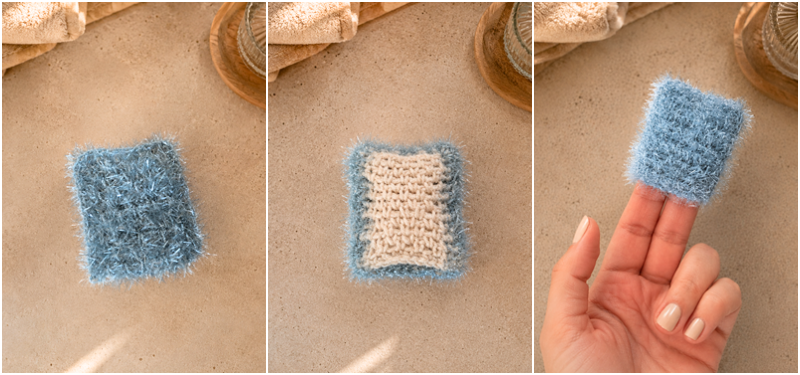
Size
approx. 5 × 6 cm / 2 × 2.4 in
The skincare pad is worked in rows.
Start with cotton yarn first, then switch to scrubby yarn.
Instructions
Ch 12 using cotton yarn.
Then work 14 rows in the mesh stitch pattern.
After that, switch to scrubby yarn and crochet another 11 rows.
Do not cut the yarn.
Instead, fold the piece so that two different skincare sides are created:
- one cotton side
- one scrubby yarn side
Now crochet around three sides using dc stitches, leaving one short side open.
For neater corners, work 3 dc into each corner stitch.
Finally, weave in all loose ends.
Your own little “finger mitt” for your daily skincare routine is now finished.
🪸 Facial Care Pad
I especially love using this pad as a small combination of gentle exfoliation and skincare.
First, I use the textured scrubby side for soft exfoliation, followed by the cotton side for applying skincare products or for a calmer, gentler cleanse.
And honestly, I now keep several of these pads within easy reach in my bathroom.
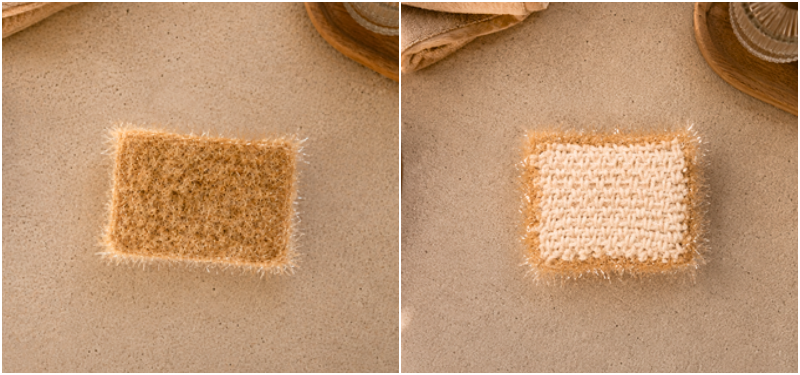
Size
approx. 7.5 × 5.5 cm / 3 × 2.2 in
The skincare pad is worked in rows.
Start with cotton yarn first, then switch to scrubby yarn.
Instructions
Ch 20 using cotton yarn.
Then work 13 rows in the mesh stitch pattern.
After that, switch to scrubby yarn and crochet another 10 rows.
Do not cut the yarn.
Instead, fold the piece so that two different skincare sides are created:
- one cotton side
- one scrubby yarn side
Now crochet around all four sides using dc stitches and close the round with a sl st.
For neater corners, work 3 dc into each corner stitch.
Finally, weave in all loose ends.
And just like that, your exfoliating and skincare pad for your daily facial routine is finished.
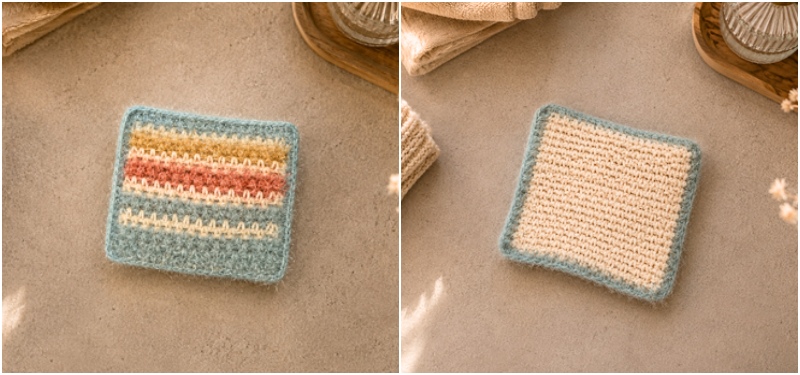
🪸 Neck Care Pad
My grandmother already taught me very early on how important proper neck care really is.
And honestly, I still think about that quite often during my little spa routines today. That’s exactly why this neck care pad has gradually become a natural final step in my own skincare routine.
Size
approx. 9.5 × 9 cm / 3.7 × 3.5 in
The skincare pad is worked in rows.
Start with cotton yarn first, then switch to scrubby yarn.
Instructions
Ch 26 using cotton yarn.
Then work 23 rows in the mesh stitch pattern.
After that, switch to scrubby yarn (yellow) and work the following stripe sequence:
- 2 rows scrubby yarn (yellow)
- 2 rows cotton yarn
- 2 rows scrubby yarn (pink)
- 2 rows cotton yarn
- 2 rows scrubby yarn (blue)
- 2 rows cotton yarn
- 4 rows scrubby yarn (blue)
Do not cut the yarn.
Instead, fold the piece so that two different skincare sides are created:
- one cotton side
- one striped scrubby/cotton side
Now crochet around all four sides using dc stitches and close the round with a sl st.
For neater corners, work 3 dc into each corner stitch.
Finally, weave in all loose ends.
Your skincare pad for neck and décolleté care is now ready to use.
And with that, our little facial care and skincare routine is complete.
But of course, the spa series doesn’t end here — because a larger luffa sponge for the shower simply had to be part of the collection too.
And honestly, depending on my mood and the kind of skincare feeling I want, I genuinely enjoy both versions:
- the scrubby yarn luffa sponge for a stronger exfoliating effect
- the cotton version for a softer, calmer cleansing experience
The basic pattern itself stays exactly the same — although the cotton version turns out slightly smaller due to the different yarn texture and structure.
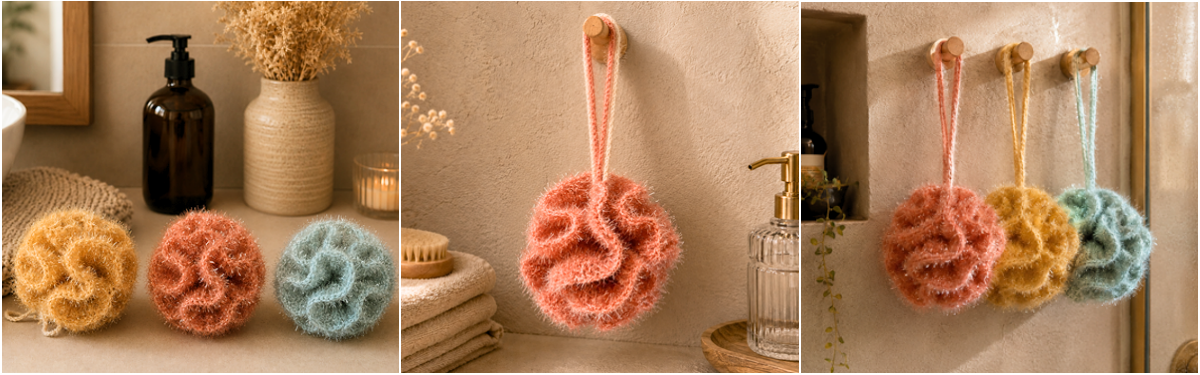
🧽 Shower Luffa Sponge
Sizes
- cotton version: approx. 8 × 8 cm / 3.1 × 3.1 in
- scrubby yarn version: approx. 11 × 11 cm / 4.3 × 4.3 in
This project is another perfect example of how dramatically the final result can change simply depending on the yarn you use.
Same pattern.
Same hook size.
And yet the finished sponge feels completely different.
The luffa sponge is worked in rounds.
In this pattern, the two-color scrubby yarn version is used:
Start with the color Natural first, then switch to your preferred main color (yellow, pink, or blue).
If you crochet the cotton version instead, the pattern itself stays exactly the same — you simply work the entire sponge in one color using your chosen cotton yarn.
Instructions (Rico Creativ Bubble)
Natural
Start with a magic ring or ch 6 and join with a sl st to form a ring.
Round 1
ch 1 (counts as the first dc),
work 19 dc into the ring and close the round with a sl st. (= 20 sts)
If you would like to hang your luffa sponge, you can now additionally crochet a hanging loop with approx. 80 ch (or your preferred length) and attach it with a sl st.
Round 2
The stitches are increased fivefold:
ch 3 (counts as the first tr),
work 4 tr into the same stitch,
then work 5 tr into each dc from the previous round.
Close the round with a sl st. (= 100 sts)
Round 3
ch 3 (counts as the first tr),
work 1 tr into each tr from the previous round and close the round with a sl st. (= 100 sts)
Round 4
Now switch to your chosen main color (yellow, pink, or blue).
The stitches are increased fivefold again:
ch 3 (counts as the first tr),
work 4 tr into the same stitch,
then work 5 tr into each dc from the previous round.
Close the round with a sl st. (= 500 sts)
Round 5
ch 3 (counts as the first tr),
work 1 tr into each tr from the previous round and close the round with a sl st. (= 500 sts)
Now simply weave in all loose ends carefully — and your large shower luffa sponge is ready to use.
Handmade Gifts That Actually Get Used
And honestly — if we’re already crocheting all of these little skincare and bathroom accessories, why not surprise someone else with them too?
Because projects like these often feel surprisingly high-end and thoughtful as gifts.
Especially when combined with:
- natural soaps
- wooden trays or bowls
- soft towels
- small spa sets
- bathroom gift boxes
they instantly create a calm, cozy, and very personal atmosphere.
And that’s exactly why I genuinely love giving handmade projects like these as gifts these days.
Not necessarily as a huge present — but more as a small personal gesture with real everyday value.
Because somehow, these kinds of handmade pieces suddenly feel much more special when they’re not just decorative, but actually useful in daily life too.
Why These Small Projects Surprised Me So Much
Maybe that’s actually my real conclusion about this whole topic:
I honestly never expected bathroom accessories of all things to win me over quite this much.
Especially not when they’re made from a yarn I originally associated mostly with dish scrubbies and household projects.
And maybe that’s exactly why I love this idea so much now.
Because it shows that materials aren’t fixed to one purpose.
Sometimes, simply placing something in a completely different context changes the entire feeling of a project.
And honestly, that’s exactly what I love about handmade crafts:
A small idea can suddenly turn into something that genuinely becomes part of everyday life.
At the same time, though, one important thing still applies here too:
Especially if you have sensitive skin, it’s always a good idea to test new materials carefully first. Personally, I tolerate both cotton and scrubby yarn very well, but every skin type reacts differently.
That’s why I would always recommend testing textured yarns gently first — especially for facial care or more sensitive areas of the skin.
Maybe You’ll Discover Your Next Favorite Project Too
If you enjoyed this topic, feel free to stop by again from time to time — because this little luffa and spa-inspired crochet series is still growing step by step.
Over the next few weeks, I’ll be working on even more ideas around:
- back scrubbers
- washcloths
- textured spa sponges
- bathroom accessories
- sustainable handmade projects
A new design from the Coral Spa Collection is already in progress as well.
So feel free to stay tuned and follow along as the series slowly continues to grow.
Sometimes, sustainability begins with just a single stitch.
🧶 What do you think about this topic?
I’d truly love to hear your thoughts, ideas, and experiences in the comments.
📸 Maybe you’re already tempted to crochet one of these little projects yourself?
If you do, I’d absolutely love to see your version or hear about it — one of my favorite things is seeing how creatively different people interpret these small spa-inspired crochet ideas.
✨ And if you enjoy my articles, I’d of course be very happy if you followed me here on CrazyPatterns so you don’t miss any new blog posts, ideas, or crochet patterns in the future.
🧡 Maybe you’ll also discover a few more articles in my CrazyPatterns blog — or perhaps find a crochet pattern in my shop that inspires your next project.
With love,
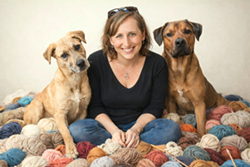
Kathrin with Emma & Muki
Photos, designs & content © Kathrin | stricken-im-trend.com


