Hi everyone,
I find very nice patterns here. My only problem is the size.
The patterns usually only state the yardage and whether it’s 3-ply or 4-ply... but I miss the information in grams. E.g. 280 m yardage/50 g
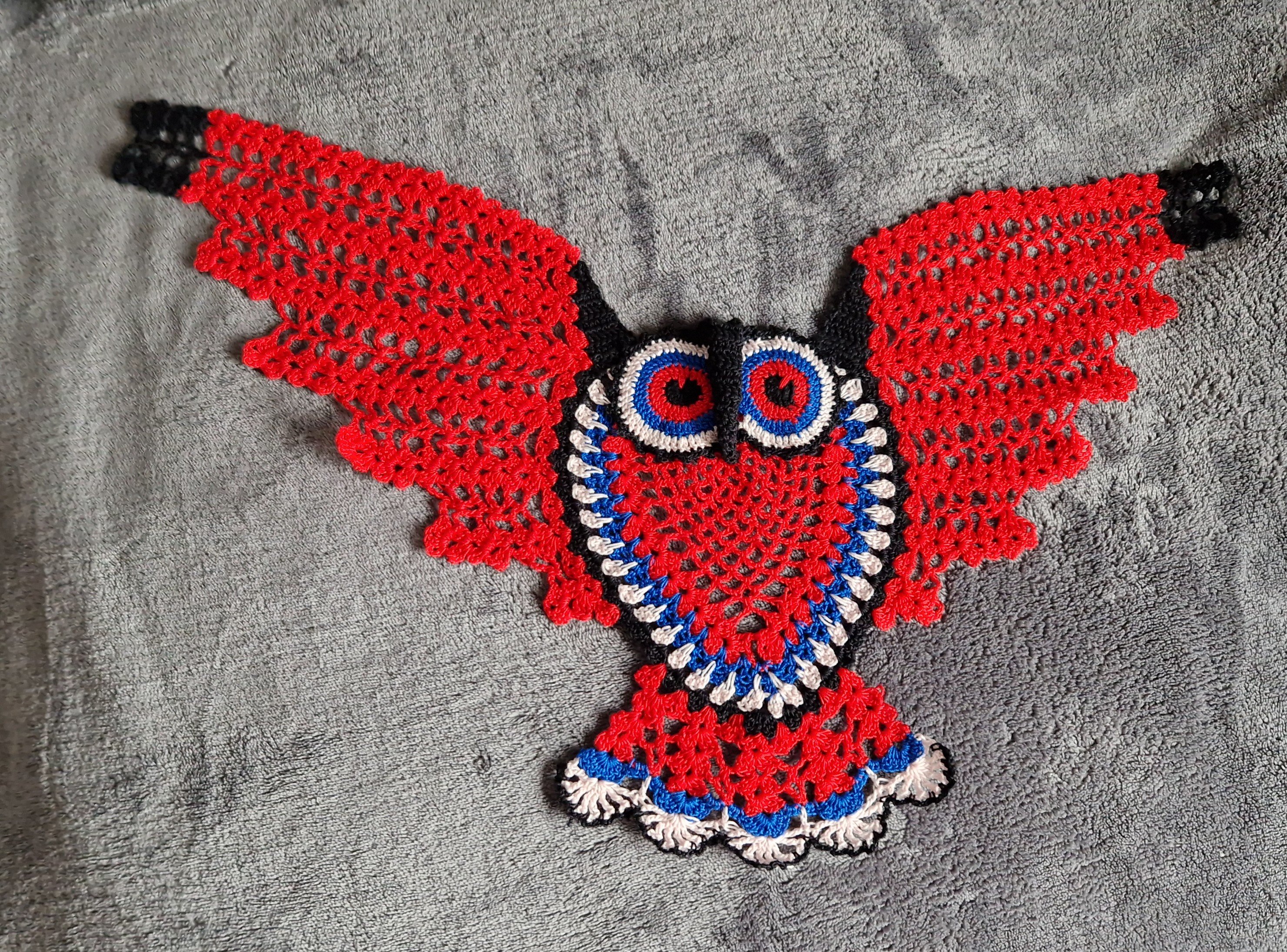
I crocheted an owl shawl, which also turned out well, dimensions 48 x 30 cm.
Nice as decoration, but as a wrap it’s more for a doll
Best regards, Thilde
I think this has a bit to do with the different countries. Americans always specify only the yardage or the yarn type. For projects with yarn cakes (mostly for shawls), it’s often a combination of yardage and yarn weight.
In German-speaking countries, it’s the yardage per 50 g.
The “3-strand” or “4-strand” likely refers to yarn cakes, usually made of 50% cotton and 50% acrylic, where the strands are held together but not twisted.
These are often sold by length, which is why many patterns don’t include the weight in grams.
I crocheted my “Blätterzauber” shawl in a granny pattern using a 750 m, 3-strand yarn cake, and it turned out to be a good size. The yarn cake weighed 150 g.
The same shawl made with 1,000 m (weighing 200 g) would have about 12 more rows, making it slightly larger.
That’s also a nice size.
Any more yardage would have made it too big for me. Less than 750 m would probably have been too tiny.
Otherwise, a gauge swatch can also help you.
That way, you can see in advance whether your hook size, your tension, and the yarn you’ve chosen will result in a size roughly matching the one in the pattern. Switching to a smaller or larger hook size might give you the desired result.
This also applies to knitting patterns.
Is it really sooo difficult to include both the weight in grams and the yardage per 50 g (or per 100 g, if the yarn is sold that way) in a pattern? I’d also like the fiber composition to be listed in percentages. In magazine patterns, these three details are almost always included. With patterns in books, you often have to consult a search engine first to get more precise details.
Why am I so fixated on this information?
Sometimes you want to—or have to—substitute a “recommended” yarn with another, for example, because the intended one isn’t available, is too expensive, or you’d like to use up yarn you already have. In those cases, you’re grateful for any information that helps you find a suitable alternative.
I’d be reluctant, for example, to replace pure wool with cotton because the two fibers have very different properties. Wool keeps you warm, while cotton doesn’t do nearly as good a job. Wool is usually light, while cotton can feel quite heavy hanging off you. For example, I find summer sweaters made of cotton and/or novelty yarn that weigh 750 g or more simply unbearable. Just wearing them makes you break a sweat. And once cotton is soaked with sweat, you’ll end up freezing in it. Winter sweaters made of wool sometimes weigh less than 500 g and still keep you warm even when they feel a little “clammy” on the outside.
I’m happy when the information about the materials is just as comprehensive and precise as the pattern itself. It not only makes it easier for me to make the project, but also helps me decide whether I want to make it or whether I’d rather steer clear of it because, based on my experience, the yarn isn’t very well suited for the purpose.
42 prizes / total value €300:
30×€5, 10×€10, 2×€25 – simply activate the newsletter.
No purchase necessary. Unsubscribe at any time. Prizes are awarded as Crazypatterns shopping credit.
Learn more
To enhance user experience, we use cookies, including for analysis, optimization, and advertising purposes, in accordance with our Privacy Policy and Cookie Policy. Some of our partner services are located outside the EU. You can change your settings at any time. If you select "Decline", we will only use essential cookies.