Forum Categories
Quick to Target
Browse Categories
Community & Help

Craft Tips

22705 Posts Recent Started
Tuesday, July 26, 2016 at 2:21 PM
Dear users and authors,
this thread is the place for the very best crafting tips—or all the tips you wish you’d known much sooner.
Have fun!

3344 Posts Recent Started
Tuesday, July 26, 2016 at 4:07 PM
What do you do when the ball of yarn runs out? In the past, I simply knotted the threads together and left the ends hanging on the back. On a sweater, you couldn’t see it anyway. *ahem*
Today I’m a bit “smarter.” For one thing, ugly threads are of course visible on shawls, scarves, etc. For another, simple knots can also come undone pretty easily.

That’s why today I use 2 different methods to continue with a new ball of yarn when the old one is running low:

1. The so-called “Russian join.” 
The link leads to an English page, but the pictures are self-explanatory.

2. The “Frankfurt knot.”
This is also a knot, but it really is absolutely tear-proof and works very well with thin lace yarns that can’t be joined with the Russian join.

795 Posts Recent Started
Wednesday, July 27, 2016 at 10:07 PM
The hassle of weaving in the beginning and end yarn ends

To save myself the trouble of weaving in the beginning and end yarn ends at the end of my project, I crochet them directly into the piece.
Especially when changing colors frequently, weaving in the ends is a real hassle.
You’ve finally finished your crochet project, and then you still have to go through the tedious
process of weaving in each individual thread.

I catch these ends with my hook as I crochet and work them right into the piece.
So, after I’ve picked up the yarn for the next stitch, I place the starting thread on the hook, behind the stitch I’m about to crochet.


By the way, this also works great when you run out of yarn and need to start a new ball.

Since I don’t crochet shawls or other garments myself—I mainly make amigurumi—I don’t know if this method works for those projects, of course.

But maybe this is a pretty good tip for some of you.

Best wishes, Doreen

22705 Posts Recent Started
Monday, August 1, 2016 at 1:36 AM
Thanks for the tips so far.
Are there any more?
In my opinion, this is an important topic.

Monday, August 1, 2016 at 11:17 AM
The head is crooked ;-)

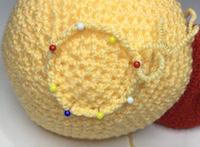
To prevent the head of an amigurumi from being sewn on crookedly or wobbling, place the head on the body before sewing it on and use pins to mark several points. Then wrap a strand of yarn around the pins and lightly trace the inside of this *circle* with a thin pen. Work single crochet stitches around the body along this circle. The number of stitches should roughly match the head opening. This makes it very easy to sew stitch to stitch. Stuff it well one last time just before finishing.


Monday, August 1, 2016 at 11:38 AM
The legs crocheted onto the feet

If you want the legs of your amigurumi to be crocheted onto the feet as evenly as possible, there’s a simple trick.
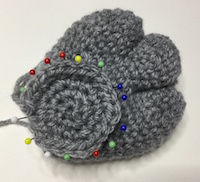
Depending on how thick I want the legs to be, I crochet a *small swatch* in that size and place it on the foot. I then pin marker pins around the outside edge of the *small swatch*. This makes it easy to work the stitches along that marking so both legs sit evenly on the feet.

22 Posts Recent Started
Monday, August 1, 2016 at 12:09 PM
Hello,
I think this is a great idea; I’ll try it out right away on my next piece.
But another question:
for me, the final rounds always get holey; that means when the stitch count for the head, for example, is coming to an end, the stitches get too big. This makes the lower part always look silly. How can I improve that?

Monday, August 1, 2016 at 12:47 PM
Hi Friemeline,
I hope I understood your question correctly. If the last decreases end up too holey, it might be because the decreases are worked too close together. In other words, you’re decreasing too quickly. For experienced crocheters, I recommend changing the number of stitches during the decreases and starting this process early on. If that’s not possible and the holes are too “visible,” here’s another tip from me… It does happen—especially when crocheting a head—that different types of stitches are used. Then the stuffing might show through. Or the bear’s eyes might not attach properly at that exact spot because, for example, there are double crochets there instead of single crochets. For small spots like this, it helps to crochet a little *patch*—just big enough to cover where “the stuffing is showing through”—(using the same yarn, of course) and sew it onto the body or head from the inside before stuffing. Nothing will show through anymore, and you won’t see it after stuffing either. This is a great alternative, especially for less experienced crocheters, before you end up fiddling around with the pattern unnecessarily ;-) 

22 Posts Recent Started
Monday, August 1, 2016 at 2:47 PM
Hmm, I always thought that if I increase for three rounds, I’d keep the same number of stitches for three rounds and then decrease again over three rounds, so that the head or belly would be round too. Am I wrong about that?

Monday, August 1, 2016 at 3:00 PM
I wouldn’t just say yes to that. It depends on the number of stitches, the yarn weight... some people also have the misconception that you simply have to double everything in a pattern so that the finished piece will be twice as big.

22 Posts Recent Started
Monday, August 1, 2016 at 7:03 PM
No, I don’t think that’s really possible. Things like that actually work out pretty well too. It happens to me a lot—when I’m making something myself, I can’t quite get the last few rounds right. Is there some kind of formula for calculating them?
For example, if I’m making a 24-stitch ball, what should the ending look like?

Tuesday, August 2, 2016 at 12:32 AM
With a ball like this, it’s actually quite simple. 6-12-18-24… that’s obvious. Then 3 or 4 rows (I let the look decide, depending on the yarn) in single crochet. Decreases are done the same way as increases. And if holes form during the decreases on such small items, just pull the yarn tight as you decrease. The side with the decreases is usually the bottom side anyway, so it won’t be noticeable there. So it’s best to make sure the loop on the hook is always nice and tight before you insert the hook into the stitch. Then the problem of holes should be solved for these little projects.
As for whether there’s a rule of thumb… hmmmm… I haven’t the faintest idea ;-) I think the best approach—at least in my opinion—is to go by how it looks. For me, crocheting is about creativity and the fun of *tinkering* ;-) And if not every piece looks exactly the same… that’s precisely what makes it special when you crochet the same amigurumi multiple times. 
That reminds me of something else……
It makes sense to finish crocheting identical parts of an amigurumi (like arms, legs, or feet) all in one day. At least in my case, I’ve noticed that my tension varies from day to day. And you can actually see that in the final result. 

Tuesday, August 2, 2016 at 12:46 AM
How tightly should I stuff it?

Sometimes you’re not sure how much stuffing to put in a piece. What looks good while you’re stuffing it might look a little different once you’ve sewn the pieces together. I often stuff smaller pieces with a little extra stuffing. Once the amigurumi is finished, I simply use my crochet hook to pull out as much stuffing as needed from the spots where it seems too full, until it looks just right to me. This is easier than laboriously adding more stuffing through tight stitches after the project is finished. 

22 Posts Recent Started
Tuesday, August 2, 2016 at 10:49 AM
Thanks for your replies and your patience :D.
I only recently got into amigurumi and think these little things are great. I’ve always loved crocheting and knitting, but now that the kids are grown up, they don’t wear knitted sweaters and “stuff” like that anymore (who knows why :). Also, my wrists can’t handle working on such big projects anymore, but these little bag charms and figures no bigger than 15 cm are very popular here. As soon as I finish something, it’s gone in a flash :).

Tuesday, August 2, 2016 at 11:06 AM
No problem :-) Have fun crocheting. If you ever have questions about amigurumi—even if they’re not related to my patterns—feel free to send me a private message anytime.
 

3407 Posts Recent Started
Tuesday, August 2, 2016 at 11:12 AM
Hi everyone!

On the topic of "decreases": for sc, I always use the so-called invisible decrease (there are great videos online for this—just Google it). Here, you don’t pick up a loop from 2 sts and crochet them off together; instead, you pick up the front loop of the two sts to be joined and crochet them off together. This prevents a bump from forming, as can easily happen with a normal decrease, and it also doesn’t leave a little hole. And I think—but this is a matter of taste—that it looks better.


Crocheting double crochet in rounds: e.g., for hats

Often a visible "seam" forms at the spot where you have closed the round with a sl st and then start again with turning chains as the 1st dc.
To prevent this, you can work a so-called false dc instead of the turning chains (you can also find great videos on Google under this term). It is barely noticeable and makes the work look neater.

Changing colors:

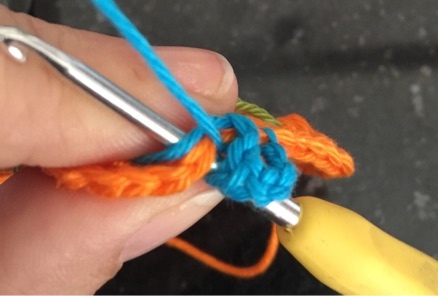
If you want to change the yarn color, you should work the last st in the old color only up to the second-to-last loop and already finish the st in the new color. In other words: when working sc, for the last sc in the old color you still yarn over with the old color, and then finish the st with the new color.

Best regards

22 Posts Recent Started
Wednesday, August 3, 2016 at 9:29 AM
@Zwergnasebaer.
Thanks for the tips, I'll take them to heart.

@Wolligurumi:
A big thank you to you too, you've already been a great help. I found my mistake (I simply started decreasing with too few stitches); now the ball is round and tight all the way around :)

2748 Posts Recent Started
Friday, August 5, 2016 at 1:52 AM
The Gauge Phenomenon:
Have you ever experienced this? You’ve made a wonderful gauge swatch (at least 10 cm x 10 cm), but then the finished dimensions of your crocheted or knitted piece don’t match—even though you calculated everything correctly!
A tip from experienced knitters is this: Let your gauge swatch rest for at least one day , since “freshly worked” stitches can still change. Some people wash and dry the gauge swatch flat—just as they would later do with the finished crocheted or knitted piece. Only then should the gauge swatch be used for your calculations.

This patience pays off especially when using yarns that are difficult to unravel, such as mohair.

Wishing everyone every success.

You can find more information about gauge swatches on my blog at
https://www.crazypatterns.net/en/blog/667/maschenprobe-umrechnen-so-geht-s

Write Reply

Please register or Log in!

Latest comments

4 actual comments last by Operator
Yesterday at 11:14 PM
23 actual comments last by CreatOwl
Yesterday at 8:44 PM
4 actual comments last by bianca-aguck
Yesterday at 7:53 PM
5 actual comments last by Schnuckelina
Jun 21, 2026, 5:10 PM
15 actual comments last by Nadeladdict
Jun 21, 2026, 2:32 PM

Popular patterns

Top patterns from Natalija from the Crochet category!
Top patterns from MorbenDesign from the Crochet category!
Top patterns from elke-eder from the Crochet category!
Top patterns from stricken-im-trend from the Crochet category!
Top patterns from NiggyArts from the Crochet category!
Top patterns from stricken-im-trend from the Crochet category!
Top patterns from stricken-im-trend from the Knitting category!
Top patterns from stricken-im-trend from the Crochet category!
Top patterns from KuemaTutorials from the Crochet category!
Top patterns from elke-eder from the Crochet category!
More top patterns

Free patterns

Top patterns from MorbenDesign from the category!
Top patterns from jennysideenreich from the category!
Top patterns from MorbenDesign from the category!
Top patterns from Hobbii from the category!
Top patterns from MorbenDesign from the category!
Top patterns from Miralay from the category!
Top patterns from MorbenDesign from the category!
Top patterns from Hobbii from the category!
Top patterns from KuemaTutorials from the category!
Top patterns from MorbenDesign from the category!
Top patterns from Dianas-kleiner-Haekelshop from the category!
Top patterns from NataliSkill from the category!
Top patterns from Hobbii from the category!
Top patterns from christina-lemberger from the category!
Top patterns from martina-supova from the category!
Top patterns from Hobbii from the category!
Top patterns from ternuraamigurumi from the category!
Top patterns from DIY-4U from the category!
Top patterns from JosephinesPuppenstuebchen from the category!
Top patterns from kandjdolls from the category!
Top patterns from ternuraamigurumi from the category!
More free patterns

Win shopping credit every month!

42 prizes / total value €300: 30×€5, 10×€10, 2×€25 – simply activate the newsletter. No purchase necessary. Unsubscribe at any time. Prizes are awarded as Crazypatterns shopping credit. Learn more