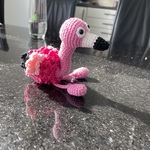
I really enjoy making amigurumi. Unfortunately, I have piles of them at home, and because they lack CE marking, I’m not actually allowed to sell, donate, or even give them away.
What am I supposed to do with them? The only options I’ve come up with so far are sending them to Africa or Pakistan (which I’d rather not do—I have enough children of my own who would love them, but I’m not officially allowed to), or throwing the whole lot in the trash, but that’s too wasteful for two months’ worth of work.
(Unfortunately, I don’t know anyone in my circle of friends who would want them.)
What makes you think you’re not allowed to give away or sell something you made yourself, or that you need a CE mark for it? With the CE mark, the manufacturer confirms that certain EU-wide directives and standards are being met. The mark is required for the European single market—in other words, if you want to mass-produce items by machine and sell them throughout Europe. Whether it’s socks, figurines, or jam, homemade items never have a CE mark. ;) If you specify when giving them away or selling them whether and how the items can be washed or cared for, and whether they’re suitable for children under 36 months, that should be more than enough.
Please do some research on this. CE marking for toys:
Anything that’s meant for play or is shaped like an animal must be CE-certified (safety-tested)—this also applies to homemade items. Otherwise, you could face legal consequences.
The CE marking requirement only applies within the EU.
If you sell this stuff to the U.S. or somewhere like that, it’s legal. Within the EU, you’re not allowed to, and you’ll be fined 100,000 if they catch you or if someone rats you out.
The issue of CE marking has been making the rounds in craft forums for quite some time.
Crocheted animals and anything crocheted or knitted that encourages play andis sold, even for charitable purposes or donations, is subject to mandatory CE marking.
Christin is completely right with her statement above.
Many people are still not aware of this at all, or they sell under the motto “where there’s no plaintiff, there’s no judge.” Maybe they also point out that it is not a toy, but a decorative item.
According to this page *Link removed, Mod*, the Product Safety Act applies only to individuals or companies (including associations) that make products available on the market as part of a business activity
. According to this page, this does not apply to private individuals without relevant business activities who privately make items to donate. The same applies when homemade toys are given as gifts within a family or circle of friends. Homemade clothing that is given as a gift or donated also does not need to be labeled.
I actually asked the relevant authority—perhaps a bit naively—whether I’m now no longer allowed to make toys for my grandchildren, or whether I have to spend weeks poring over incomprehensible standards and regulations and filling out pages of forms for every homemade toy before I can give it away. Let’s see what they say.
The *link* also points out that, according to the 2nd ProdSV, the CE marking applies ONLY to toys that are sold or given away as part of a business activity.
Does that mean I would officially be allowed to sell my first pieces after all, or still not, because that would again count as a business activity? (There are only first pieces, no second ones.)
Giving them away is okay—I don’t have to worry about anyone getting on my case for that.
It’s great to see such a lively discussion here. I’d just like to ask that you please don’t include external links in your posts or screenshots from external sites. I’ll unfortunately have to remove them.
I hope you continue to enjoy the forum.
Questions about the CE marking are answered here: info-zentrum@baua.bund.de.
There, too, I was referred to the 2nd ProdSV and told that giving away homemade items doesn’t constitute a commercial activity. I interpret this to mean that even homemade donations don’t require a CE marking if you’re not engaged in any relevant commercial activity.
Oops, I didn’t notice the part about external links until it was too late. So here’s the info without a link: The official federal agency responsible for all questions regarding CE marking is the “BAuA” (Federal Institute for Occupational Safety and Health).
I just asked them whether children are allowed to sell homemade toys they’ve received as gifts at a flea market as a hobby at some point, or whether they’d have to obtain a CE marking for each unique item (!) beforehand. At the same time, I asked whether it is really the intention that private individuals who, as a hobby(!), occasionally wish to sell small quantities of homemade toys—for example, at church Christmas bazaars or for fundraising—need a CE marking for every toy they sell.
I’m sharing the answer here.
In my legal opinion, a hobby is not a business activity, even if the hobby occasionally generates small amounts of money. On the other hand, one could also make goods available on the market through a hobby. In this regard, I am curious to hear what the BAuA has to say on the matter.
I had absolutely no idea this was even an issue here in Denmark! Nobody here gets a CE certification for homemade items! If I told someone this, they’d call me a liar! 🤗😂😅 Do I really have to take this seriously?
Best regards from your vacation destination 😎
@juttacornelia: Why don’t you ask the relevant authority in Denmark whether you need a CE marking for toys you’ve made yourself as a hobby if you want to sell them occasionally—for example, at flea markets and bazaars—or to raise funds, say, for the local sports club? I’d find it really interesting to hear how they view this there. After all, everything should be the same across the EU.
This topic interests me, too. I’m curious to see how it turns out. I actually create patterns for amigurumi. Over the years, I’ve accumulated quite a few animal figures. I give some away personally, but I don’t have that many people in my circle who’d want them. I’d actually like to donate or sell them for a good cause. Since they’re all one-of-a-kind pieces, certification isn’t an option.
I’m wondering at this point whether my work as an author constitutes a “relevant” business activity in this sense?
By the way, some sellers try to exempt themselves from the labeling requirement by pointing out that the items aren’t toys but decorative items. But that isn’t effective. Just wanted to add that.
Mod edit regarding the following post by blickfang-design:
This is not legal advice and cannot replace legal advice. If in doubt, please speak with a lawyer.
To put it very briefly:CE marking requirement:
Private donation within family or a close circle of friends = giving something away in a private setting
If you only pass on Amigurumis to family or close friends, there is no CE marking requirement.
Example: You crochet a stuffed animal for your sister’s daughter → no requirement.
Public donations / organizations / institutions
If you donate Amigurumis to kindergartens, schools, charities or at flea markets/events:
The product is considered to be “placed on the market” → CE marking required.
The safety requirements of the EU Toy Safety Directive must be met.
As soon as you sell products to other people, give them away, or make them publicly available, e.g. on Etsy, at a flea market, or in an online shop:
The CE marking requirement applies.
You must comply with the EU Toy Safety Directive and provide proof of conformity.
Mod edit regarding the post by blickfang-design:
This is not legal advice and cannot replace legal advice. If in doubt, please speak with a lawyer.
Hi Christin,
I’ve been thinking some more about what you could do with the amigurumi. Have you ever considered donating them to nursing homes, dementia care groups or hospices? Many older people enjoy having figures to hold or as a little source of comfort. That way, you can be sure you’re not passing on a toy.
The CE marking requirement only applies if the items are toys as defined by the EU Toy Safety Directive (i.e., “products intended or designed to be used for play by children under 14 years of age”).
@blickfang-design:
Are you sufficiently qualified to provide legal advice on this topic?
If not, then I’d ask you to please refrain from doing so. If you do have qualifications in this area, please let me know.
@Community:
This forum cannot provide legal advice.
Just to be clear: This isn’t legal advice, just a bit of back-and-forth. For anything official, please consult a lawyer.
“Just a little guidance—I won’t say anything without my lawyer 😉.”
What a discussion!
Seriously? What else is regulated by law these days? No matter how many laws there are, you can’t protect against harm. You can only shake your head at that. If it’s not the stuffed animal, it’s the kids’ jacket that might have little buttons—which are perfect for chewing on as a kid. Or that awesome princess dress with sequins that sparkle so beautifully and can be easily taken off to use as a doll’s dress. Kids do things adults wouldn’t even think of. (Sticking peas in their ears and nose.) I think it’s terrible to keep coming up with more and more legal regulations just to make everything seem so safe. No one can keep track of it all anymore, and even then, you can’t prevent everything. But that’s just my opinion.
42 prizes / total value €300:
30×€5, 10×€10, 2×€25 – simply activate the newsletter.
No purchase necessary. Unsubscribe at any time. Prizes are awarded as Crazypatterns shopping credit.
Learn more
To enhance user experience, we use cookies, including for analysis, optimization, and advertising purposes, in accordance with our Privacy Policy and Cookie Policy. Some of our partner services are located outside the EU. You can change your settings at any time. If you select "Decline", we will only use essential cookies.