
For more than ten years, I've had the pleasure of accompanying knitters and crocheters with my patterns. And over the years, there are certain questions that come up again and again.
Some of them have become such a familiar part of my daily work that I can almost predict when they'll arrive.
Sometimes someone writes to me right after purchasing a pattern. Sometimes they're already halfway through their project. And sometimes the message doesn't land in my inbox until the first sleeve has already been knitted or crocheted.
Many of these questions can be solved with a little background knowledge and a few practical steps. And that's exactly what 💙 #StitchWisdom is all about:
Instead of dry theory or general advice, I share knowledge from my everyday work as a designer – clearly explained and made practical so you can use it for your own knitting and crochet projects.
Today, we're starting with a question that almost every knitter or crocheter has probably asked at some point:
"Kathrin, the original yarn has been discontinued. Can I simply use a different one?"
My short answer?
Yes.
My slightly longer answer...
...will take you through 6 steps to finding the right yarn substitute. 😊
I think we've all experienced that moment...
You've just downloaded your new pattern.
Maybe you've even planned the perfect weekend to make it.
You open the materials list, look for the recommended yarn...
...and then comes the disappointment.
Discontinued.
Or:
Out of stock.
Or:
Only available in bright pink. 😉
Don't worry.
You're definitely not alone.
This happens all the time, especially with patterns that have been available for several years. Yarns are discontinued, replaced by new collections, or quietly disappear from the range altogether.
And that's exactly why I'm asked this question so often.
💙 From My Own Experience
I always appreciate it when someone gets in touch before buying their yarn.
Why?
Because that's often when I can help save not only time and money, but sometimes quite a bit of frustration as well.
And honestly?
Sometimes I end up liking the chosen yarn substitute even more than the original yarn.
Can I simply use any other yarn?
Well... here's the catch.
Yes... but not just any yarn.
This is exactly where most disappointments begin.
Whenever I ask how someone chose their substitute yarn, I almost always hear one of these two answers:
"The yardage was almost the same."
or
"The recommended needle size on the ball band was the same."
At first glance, that sounds perfectly reasonable.
Unfortunately, that's often not enough.
Because a yarn is much more than its yardage or the recommended needle size.
Every yarn has its own unique character.
And that's what determines...
- how your finished project drapes,
- how soft it feels,
- how much stretch it has,
- how warm it will be,
- and sometimes even whether your sweater still looks like a sweater... or ends up feeling more like a tunic or even a mini dress. 😉
Here's My Personal Approach
Whenever someone asks me about choosing a yarn substitute, I never start by comparing the yardage or the recommended needle size.
Instead, I mentally work through the same simple checklist every time.
I first developed it during my years working in a yarn shop. Since then, it has evolved through countless projects and the many questions my customers have asked me over the years. To this day, it helps me assess yarn substitutes quickly and confidently.
I always go through these six points – in exactly this order:
- Is the yarn suitable for the project?
- Is the fibre composition similar?
- How is the yarn constructed?
- Is the yardage roughly comparable?
- What needle size does the manufacturer recommend?
- Do the gauge and drape match?
Not all of these points carry the same weight. But it's the combination of all six that determines whether a yarn substitute will truly work.
So let's take a closer look at each one.
1. Is the Yarn Actually Suitable for the Project?
Before I even take a closer look at the ball band, I always ask myself the same question:
What do I want the finished project to be like?
It may sound obvious, but it's something that's surprisingly easy to overlook.
A light, airy summer top places very different demands on a yarn than a warm winter vest or a cosy scarf.
That's why I don't start by comparing the yardage. Instead, I ask myself:
- Should the finished piece drape softly and flow?
- Should it hold its shape well?
- Should it keep me warm or feel cool against the skin?
- Will it be an everyday garment or something for special occasions?
Only after I've answered these questions do I start looking for a suitable yarn substitute.
💙 From My Own Experience
With summer garments in particular, I often receive messages like this:
"I have some beautiful merino yarn at home. Can I use that instead?"
In many cases, the answer is yes.
But a light, airy summer top can quickly turn into a short-sleeved sweater that's much better suited to cooler days.
The pattern itself still works perfectly.
It's simply the character of the finished garment that changes.
And that's something it's worth knowing before you start.
2. Next, I Look at the Fibres
If I could give you just one piece of advice today, it would be this:
Compare the fibre composition first.
Because the fibres determine...
- how your project feels,
- how it drapes,
- whether it feels cool or warm,
- how well it holds its shape or how much stretch it has,
- and even how it behaves after washing.
The yardage tells you how many metres of yarn are contained in a 50 g or 100 g ball. Together with the ball weight, it gives you a good indication of whether two yarns are roughly in the same weight category.
What it doesn't tell you is whether your finished project will drape beautifully, hold its shape, or feel cool and comfortable against the skin.
That's where the fibre composition makes all the difference.
🔎 A Quick Example
Let's say a pattern was originally designed using a cotton yarn.
Now you're in your local yarn shop and find another yarn with almost exactly the same yardage.
Perfect?
Maybe.
But then you take a closer look at the ball band:
- 50% cotton
- 50% Lyocell
Suddenly, things start to change.
Your finished garment will probably have a softer drape, a subtle sheen, and often feel even cooler against the skin.
And that's not a bad thing at all.
Quite the opposite.
For summer tops in particular, I often think these fibre blends are absolutely beautiful.
This example perfectly illustrates why the fibre composition is often far more important than matching the recommended needle size.
⭐ My Tip
If you're trying to decide between two yarns, choose the one with the more similar fibre composition.
Small differences in yardage can often be adjusted for.
A completely different fibre composition, however, can completely change the character of your finished project.
3. Now Let's Take a Closer Look at the Yarn Construction
So far, we know this:
- The yarn is suitable for the project. ✔
- The fibre composition is similar. ✔
Now it's time to look at how the yarn is constructed.
Don't worry – it sounds more complicated than it really is.
Perhaps you've held two cotton yarns in your hands that felt completely different.
One was smooth and even.
The other felt soft, airy, or even slightly fluffy.
That's exactly what I mean.
Even though both yarns are made from cotton, they can behave very differently once you start knitting or crocheting with them.
That's why it's worth taking a closer look.
A loosely spun yarn usually creates a softer fabric with a more fluid drape.
A tightly plied yarn, on the other hand, often makes textured stitches, ribbing, and cables stand out much more clearly.
Ribbon yarns, bouclé yarns, and chenille yarns can also give a design its own distinctive character.
In many cases, the yarn construction has a major influence on how your finished project will look and feel.
💙 From My Own Experience
For textured stitch patterns and cables, I usually recommend smooth, traditionally plied yarns.
They allow every detail of the stitch pattern to shine.
A fluffy novelty yarn, on the other hand, can look absolutely beautiful—but it often hides the very details you've spent so much time creating.
That's why I always ask myself what I want the stitch pattern to highlight before choosing the yarn.
4. Only Now Do I Compare the Yardage
And now we come to the point that most people would probably check first: the yardage.
Of course, it's an important factor.
After all, it tells us how many metres of yarn are contained in a ball.
Even so, it's not my first consideration - it's only the fourth step.
Why?
Because two yarns with almost identical yardage can still produce completely different results.
They may drape differently, feel different, or have more or less elasticity.
So while the yardage is useful for comparing yarn weights, it doesn't tell you how your finished project will look, feel, or wear.
That's why I always look at the ball weight as well.
For example, 50 g / 125 m and 100 g / 250 m describe exactly the same yarn weight. It's the relationship between the weight and the yardage that allows you to make a meaningful comparison between two yarns.
However, the actual weight of your finished garment also depends on the fibre composition and the yarn construction.
A loosely spun alpaca yarn, for example, behaves very differently from a tightly plied cotton yarn - even if both have a similar yardage.
💙 From My Own Experience
That's why I always follow one simple rule:
Never compare the yardage on the ball band alone. Always look at the complete picture: fibre composition, yarn construction, yardage, and ball weight.
The more closely these characteristics match, the more likely it is that your finished project will resemble the original.
Small differences can often be compensated for by choosing the right needle size and knitting or crocheting a careful gauge swatch.
5. Now I Look at the Recommended Needle Size
This is where many people start their search.
After all, the ball band usually states something like:
Recommended needle size: 4.0-4.5 mm
Of course, I look at this information too - but only after I've compared the fibre composition, yarn construction, yardage, and ball weight.
Why?
Because the recommended needle size simply reflects the range that the manufacturer recommends for that particular yarn.
It's a useful guideline - but it doesn't guarantee that you'll automatically achieve the gauge specified in your pattern.
That's why my final step is to check whether both yarns also fall within a similar recommended needle size range.
💙 From My Own Experience
It's not uncommon for two yarns to have very similar characteristics while the manufacturer recommends different needle sizes.
That's often due to the yarn construction.
A loosely spun or fluffy yarn is usually worked with a slightly larger needle than a tightly plied yarn of the same weight.
That's why I don't see the recommended needle size as a deciding factor. Instead, I treat it as another useful clue about how a yarn is likely to behave and what kind of fabric it will produce.
⭐ My Tip
Don't worry if the recommended needle size is 0.5 mm larger or smaller.
In the end, what really matters isn't the number printed on the ball band - it's whether your own knitting or crochet style allows you to achieve the gauge specified in the pattern.
And that brings us to - last but definitely not least - the gauge swatch.
6. And Finally, the Most Important Step of All
If there were one step I would never skip, it would be this:
The gauge swatch.
Yes, I know...
It's probably not the most exciting part of starting a new project.
And I'll be completely honest...
Sometimes I'd love to skip it and dive straight in, too. 😉
But over the years, a gauge swatch has saved me - and many of my customers - countless hours of unnecessary work.
Especially when you're using a different yarn than the one recommended in the pattern, it's your best insurance against unpleasant surprises.
A gauge swatch doesn't just tell you whether your stitch and row counts are correct.
It also shows you...
- how the yarn behaves after washing,
- whether it becomes softer,
- whether it grows,
- whether it shrinks,
- and whether you actually like the fabric it creates.
That's something no ball band can ever tell you.
⭐ My Most Important Tip
Once you've finished knitting or crocheting your gauge swatch, wash and dry it exactly as you would your finished project.
Only then should you measure it.
Natural fibres, in particular, often change noticeably after their first wash.
That's why I never rely on a gauge swatch straight off the needles or hook - I always measure it after it's been washed and dried.
You've Almost Made It
Once I've worked through these six points...
- the yarn is suitable for the project, ✔
- the fibre composition is similar, ✔
- the yarn construction is compatible, ✔
- the yardage and ball weight are comparable, ✔
- the recommended needle size falls within a similar range, ✔
- and the gauge swatch matches, ✔
...I'm usually very confident that the yarn substitute will work well.
Of course, there are always exceptions.
But this exact sequence has proven itself time and time again over the years - both when designing my own patterns and when helping customers choose suitable yarn substitutes.
Now I'd like to show you just how different the results can be with three real examples from my own patterns.
Real-Life Example #1: A Yarn Substitute That's Remarkably Close to the Original
Theory is helpful - but in my experience, nothing explains it better than a real-life example.
So let me show you exactly how I approach choosing a yarn substitute.
For my knitted top MonteNegro #1, I knitted a second version as part of my "Style Knows No Size" campaign.
Not because the original yarn had been discontinued.
But because I wanted to see how a high-quality yarn substitute would influence the finished garment.
The moment I compared the two versions, one thing became obvious:
They looked remarkably similar - and yet each had its own unique character.
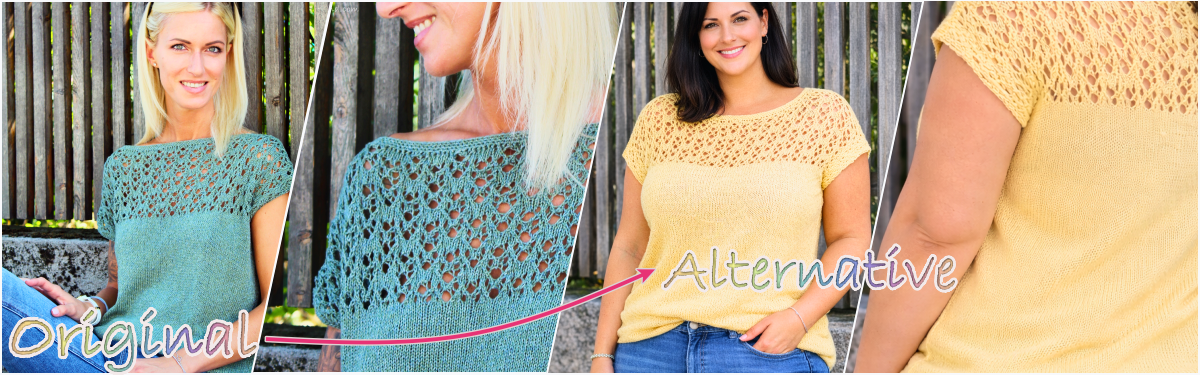
🧶 Original Yarn
Pro Lana – Montenegro (Khaki)
- 50% cotton
- 35% Lyocell
- 15% recycled cotton
- 50 g | 160 m
- Recommended needle size: 3.0–4.0 mm
- Gauge (according to the ball band): 24 sts × 34 rows
🧶 Yarn Substitute
Isager Trio 2 (Lemon)
- 50% linen
- 30% cotton
- 20% Lyocell
- 50 g | 175 m
- Recommended needle size: 3.0 mm
- Gauge (according to the ball band): 26 sts × 34 rows
Why did I choose this particular yarn?
Because it ticked almost every box on my personal checklist.
- The yarn is just as suitable for a light and airy summer top. ✔
- The fibre composition is very similar. ✔
- Both yarns contain Lyocell and plant-based fibres, although the proportions of cotton and linen differ slightly. ✔
- The yardage and the recommended needle size are very similar. ✔
- The gauge differs only slightly. ✔
In short:
The conditions for a successful yarn substitute were excellent.
What Changed?
At first glance, it's immediately obvious:
It's the same pattern - and yet the yellow version has a slightly different look.
That's not because of the design.
It's entirely down to the choice of yarn.
Here are the differences that stood out to me most:
- The Isager yarn has a softer drape.
- The fabric feels lighter and airier overall.
- Thanks to its higher linen content, the top has a more natural look with a subtle matte finish.
- The lace pattern still stands out beautifully.
In other words:
The character of the design changes slightly - but the idea behind it remains exactly the same.
Would I Recommend This Yarn Substitute?
Absolutely.
Not because it replaces the original yarn.
But because it gives the design a unique character of its own.
To me, that's what makes a truly successful yarn substitute:
It respects the original design concept while bringing its own strengths to the finished project.
🔎 What Does This Example Show?
Many people think of a yarn substitute as a compromise.
My experience has been quite different.
When the project, fibre composition, yarn construction, yardage, needle size, and gauge all work well together, the result is often not a replacement - but a second, unique interpretation of the same design.
And that's exactly what fascinates me, time and time again.
Real-Life Example #2: The Same Pattern – A Different Season
In the first example, my goal was to find a yarn substitute that stayed as close as possible to the original.
But that's not always what I'm looking for.
Sometimes I love a pattern so much that I simply want to wear it all year round.
That's exactly what I tried with my summer sweater AVINO #2.
Instead of using a lightweight summer yarn, I deliberately chose a soft, cosy winter yarn—without changing the construction or the design of the pattern.
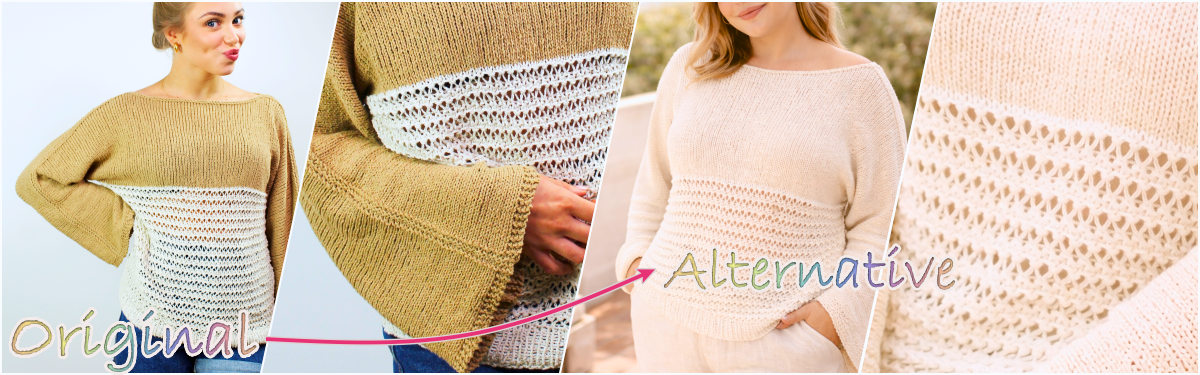
🧶 Original Yarn
Pro Lana Avino
Colours: No. 05 and No. 12
- 67% cotton
- 20% linen
- 13% polyester
- 50 g | 130 m
- Recommended needle size: 4.0–5.0 mm
- Gauge (according to the ball band): 19 sts × 27 rows
A lightweight summer yarn with excellent breathability—perfect for sweaters to wear on cooler summer evenings or during the transitional seasons.
🧶 Yarn Substitute
Lana Grossa Cashmere Kiss
Colour: No. 109
- 70% merino wool
- 30% cashmere
- 25 g | 70 m
- Recommended needle size: 5.0–5.5 mm
- Gauge (according to the ball band): 18 sts × 25 rows
A beautifully soft cashmere blend that gives the sweater a completely different feel and significantly more warmth.
Why Did It Still Work?
Even though the fibre composition changed completely, the yardage, yarn weight, and gauge are surprisingly close.
That's exactly why I was able to follow the pattern almost without making any changes.
To me, this illustrates something important:
A successful yarn substitute doesn't always have to be as close to the original as possible.
What really matters is what you want to achieve with your project.
What Changed?
The construction, stitch pattern, and fit stayed exactly the same.
And yet the sweater has a completely different feel.
- noticeably warmer
- softer to the touch
- lightly fluffy
- perfect for autumn and winter
What started as a lightweight summer design has become a sweater I enjoy wearing just as much during the colder months.
💠 My Conclusion
This example illustrates one of the most common reasons for choosing a yarn substitute.
Not because the original yarn has been discontinued.
Not because you want to use up leftover yarn.
But because you simply want to enjoy a favourite pattern in a different season.
And that's exactly why paying close attention to the fibre composition is so important.
Sometimes, simply replacing a lightweight summer yarn with a warm winter yarn is enough to transform the very same pattern into a completely new favourite.
Real-Life Example #3: What Happens When the Yarn Weight Changes Significantly?
The first two examples had one thing in common:
Although the yarns were different, their key characteristics—yardage, yarn weight, and gauge—were still relatively close.
But what happens if we take things a step further?
For this little experiment, I reinterpreted my pattern CrochetDuo 1-2-3 IDEEN #4 using a completely different yarn.
Not because the original yarn needed to be replaced.
But because I wanted to show just how much a completely different type of yarn can change the character of a design.
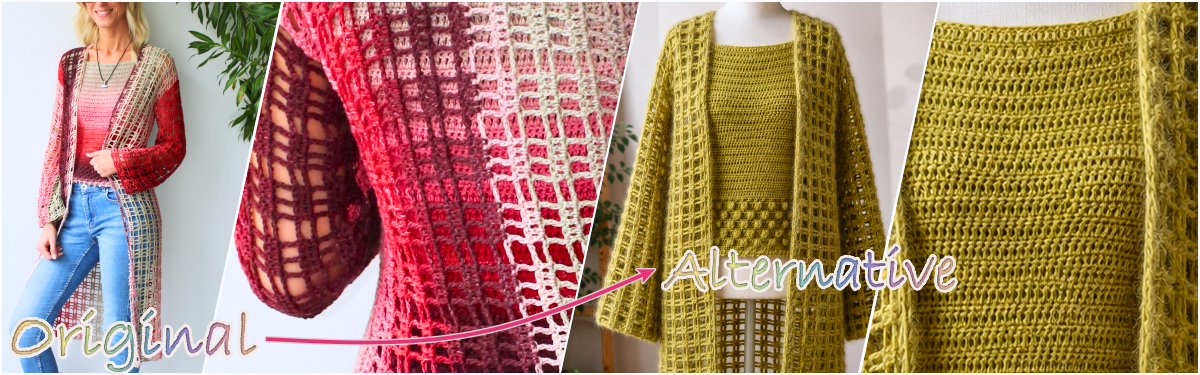
🧶 Original Yarn
Pro Lana – 1-2-3 Ideas
Colour: No. 12
Manufacturer's specifications:
- 100% Egyptian cotton
- 100 g | 315 m
- Recommended needle size: 3.0–4.0 mm
- Gauge (according to the ball band): 22 sts × 29 rows
A lightweight cotton yarn with a beautiful drape - perfect for airy summer garments.
🧶 Winter Interpretation
Lana Grossa Royal Alpaca
Colour: No. 12 (pure coincidence 😉)
Manufacturer's specifications:
- 93% Royal Alpaca
- 7% polyamide
- 50 g | 95 m
- Recommended needle size: 8.0 mm
- Gauge (according to the ball band): 10 sts × 15 rows
An exceptionally soft and voluminous winter yarn with a fluffy texture and excellent structure.
What Changed?
At first glance, one thing becomes immediately clear:
It's still based on the same original idea - but the result feels completely different.
The focus is no longer on the construction.
Nor on the colour.
It's the yarn that takes centre stage.
And with it, the entire character of the design changes.
- The garment looks much more voluminous.
- The fabric becomes soft and fluffy.
- An airy summer design is transformed into a cosy winter garment.
- The design takes on a completely different presence.
- The signature style of the pattern remains unmistakable—yet the overall impression is entirely new.
Would I Recommend This Yarn Substitute?
Yes - but with one important reservation.
This example is quite different from the previous two.
Here, it's not just the fibre composition and the feel of the yarn that change.
The yardage, yarn weight, and gauge are different as well.
That's why I would never treat this as a simple yarn substitution.
Instead, I see it as a deliberate reinterpretation of the original pattern.
🔎 What This Example Shows So Clearly
Many people automatically think of a yarn substitute as finding the closest possible replacement.
My experience has been quite different.
Sometimes it's worth being a little more adventurous and reimagining a pattern from a completely new perspective.
A favourite summer design can become a cosy companion for autumn and winter - without losing the original spirit of the design.
The greater the differences between the original yarn and the substitute, however, the more important one additional step becomes.
Because at this point, comparing the fibre composition, yardage, or recommended needle size is no longer enough.
And that's exactly when I'm usually asked the next question:
"Kathrin, how do I adapt the pattern to a different yarn weight?"
Fortunately, there's an answer to that, too.
Let's take a look at it together.
What If the Yarn Weight Changes Significantly?
If your new yarn differs only slightly from the original, carefully choosing a suitable substitute - and, of course, knitting or crocheting a gauge swatch - is often all you need.
But if you deliberately choose a yarn with a significantly different yarn weight, as we did in our third real-life example, things become a little more interesting.
At that point, it's no longer enough to compare the fibre composition, yarn construction, yardage, and recommended needle size.
Now it's your gauge swatch that determines whether you can follow the pattern as written - or whether you'll need to make a few adjustments.
It tells you exactly how many stitches and rows your new yarn produces over 10 × 10 cm, and from those numbers you can work out whether your stitch count or row count needs to be adjusted.
Don't worry - it really is much easier than it looks. 😅
When Do I Actually Need to Adjust the Pattern?
Let's look at a very simple example.
Imagine the pattern is based on the following gauge:
22 stitches = 10 cm
With your new yarn, however, you achieve:
18 stitches = 10 cm
What does that mean?
Your yarn is significantly thicker, so your finished project would automatically turn out larger if you followed the pattern without making any adjustments.
In this case, you'll need to adjust the cast-on stitch count and - depending on the pattern - often the number of rows as well.
This Is How I Do It
Whenever I deliberately adapt a pattern to a different yarn weight, I always follow the same sequence:
- Choose the right yarn first. ✔
- Knit or crochet a gauge swatch. ✔
- Only then do I start the calculations. ✔
That's actually the exact same process I use when designing my own patterns.
I never start with a calculator - I always start with a gauge swatch.
It saves an amazing amount of time in the long run.
📐 The One Formula You Really Need
Don't worry - you only need to remember one simple formula.
Step 1: Calculate the Conversion Factor
Pattern gauge ÷ Your gauge = Conversion factor
Example
Pattern:
22 stitches = 10 cm
Your yarn:
18 stitches = 10 cm
Calculation:
22 ÷ 18 = 1.22
What does that mean?
If you followed the pattern without making any adjustments, your finished project would be approximately 22% larger.
Step 2: Calculate the New Stitch Count
Now apply the conversion factor to the original stitch count.
Original stitch count ÷ Conversion factor = New stitch count
Example
Pattern cast-on:
110 stitches
Calculation:
110 ÷ 1.22 = 90.16
Since we can't knit or crochet fractional stitches, we round the result to a suitable whole number.
In this example, that would be 90 stitches.
One important point:
Make sure the new stitch count still works with the stitch pattern. Ribbing, cables, lace patterns, and many other stitch patterns often require a specific stitch multiple.
⭐ One Final Tip from My Own Experience
Many people focus almost entirely on the stitch gauge. But the row gauge is just as important.
Only when both your stitch gauge and row gauge match the pattern will your finished project have the fit and proportions you're aiming for. That's why it's especially important to check both carefully when making sweaters, cardigans, or dresses.
Don't let a different yarn weight put you off. With a well-prepared gauge swatch and these two simple formulas, most knitting and crochet patterns can be adapted to a different yarn without any difficulty.
And that's exactly what I love about our wonderful craft.
You're not tied to one specific yarn.
Sometimes, all it takes is a small change for the very same pattern to become a completely new favourite.
✔️ The Most Important Checklist at a Glance
So, to sum it all up:
If you keep these points in mind the next time you're choosing a yarn, you'll already have the most important ingredients for finding a successful yarn substitute.
- Is the yarn suitable for the project? ✔
- Is the fibre composition similar? ✔
- Is the yarn construction suitable for the desired result? ✔
- Are the yardage and ball weight comparable? ✔
- Is the recommended needle size within a similar range? ✔
- Have you knitted or crocheted a gauge swatch? ✔
- Do you need to adjust the pattern for a different yarn weight? ✔
- Have you allowed enough yarn for your project? ✔
💙 My Conclusion
If there's just one thing I hope you'll take away from this article, it's this:
A yarn substitute is not a compromise.
It's an opportunity.
Sometimes it helps you find the perfect replacement for a yarn that's no longer available.
Sometimes it gives a familiar pattern a completely new character.
And sometimes it even becomes a favourite that you love more than the original.
What matters isn't finding a yarn that's as close to the original as possible.
What matters is choosing a yarn that's right for your project.
If you carefully consider the fibre composition, yarn construction, yardage, needle size, and gauge, you can successfully adapt most knitting and crochet patterns to the yarn you want to use.
And that's exactly what I love about designing.
A pattern isn't a rigid recipe.
It's the beginning of your own creative journey.
💙 What Would You Like to Know?
Over the years, I've received countless messages about knitting and crochet – and, as you can probably imagine, many of the same questions keep coming up.
These are exactly the kinds of topics I'll be exploring in #StitchWisdom: practical questions, useful background knowledge and solutions that can help you with your own projects.
Is there something you've been wondering about or struggling with in one of your projects?
Simply leave a comment below or send me a message here on CrazyPatterns.
Maybe your question is already on my list.
Or perhaps you'll inspire a topic I haven't thought of yet.
Either way, I'd love to hear from you – your questions might just inspire one of the next #StitchWisdom topics. 💞
✨ If you don't want to miss the next episode, feel free to follow me here on CrazyPatterns. You'll be the first to hear about new articles, heartfelt projects, and, of course, my latest knitting and crochet patterns.
.png)
🧡 Perhaps you'll also enjoy exploring more articles on my CrazyPatterns blog - or maybe you'll discover your next favourite pattern in my shop.
With love
Kathrin, Emma & Muki
Photos, designs & content © Kathrin | stricken-im-trend.com


