
When the pattern is not the problem
You crochet carefully, count your stitches, use the recommended hook size and yarn - and yet your result still looks different from the photo?
Maybe your crochet piece turns out longer or shorter than planned. Maybe it drapes differently, even though you did everything right.
That is exactly what frustrates so many crocheters again and again. At first glance, nothing seems wrong. The pattern is correct, the material is correct, the stitch count is correct - and yet the final result somehow looks “different.”
The cause is often something that is rarely discussed or even consciously noticed: crochet tension, your own personal “crochet handwriting.”
Wait — isn’t this just about gauge? Not quite. Gauge tells you whether the width and height match the pattern. What I am describing here goes one step further: it helps explain why differences happen in the first place and where you can make targeted adjustments to fix these issues.
.jpg)
I personally first came across this specific issue around 10 years ago, when a customer contacted me and said there must be something wrong with my pattern. It was about my “can covers” — after completing all the steps and rounds, she still had almost 3 cm of uncovered can sticking out at the top. And I was completely puzzled. I told her that could not be right, because I had tested the pattern many times and had also had others test crochet it.
In the end, it was actually that very customer who introduced me to the topic of “Riders, Lifters and Yankers” in crochet.
Excuse me … what?? 🧐
Crochet tension is (unfortunately) more than just loose or tight
When people talk about crochet tension, it is usually reduced to a very broad distinction: loose or tight.
That is not wrong, but it only explains a small part of what is really happening in crochet. Because tension does not just affect how tight the fabric feels - it also influences how tall individual stitches become, how even the stitch pattern looks, and how a finished project develops overall.
The crucial moment often happens in a very small instant: when you pull the yarn through the stitch and a new loop sits on your hook.
That loop is far more important than it looks. It is called the golden loop - the loop in crochet that can determine what your final result looks like.
The small loop with a big effect
So many crochet movements happen automatically. Insert the hook, yarn over, pull up a loop, keep going. And because everything flows so naturally, we often do not notice how different that movement can be from one person to another.
But a lot is decided in exactly that moment.
.jpg)
If the new loop is kept short, the stitch stays lower and more compact. If it is pulled up higher, the stitch gains height and looks more open. That may sound minor, but it adds up over many stitches and whole rows.
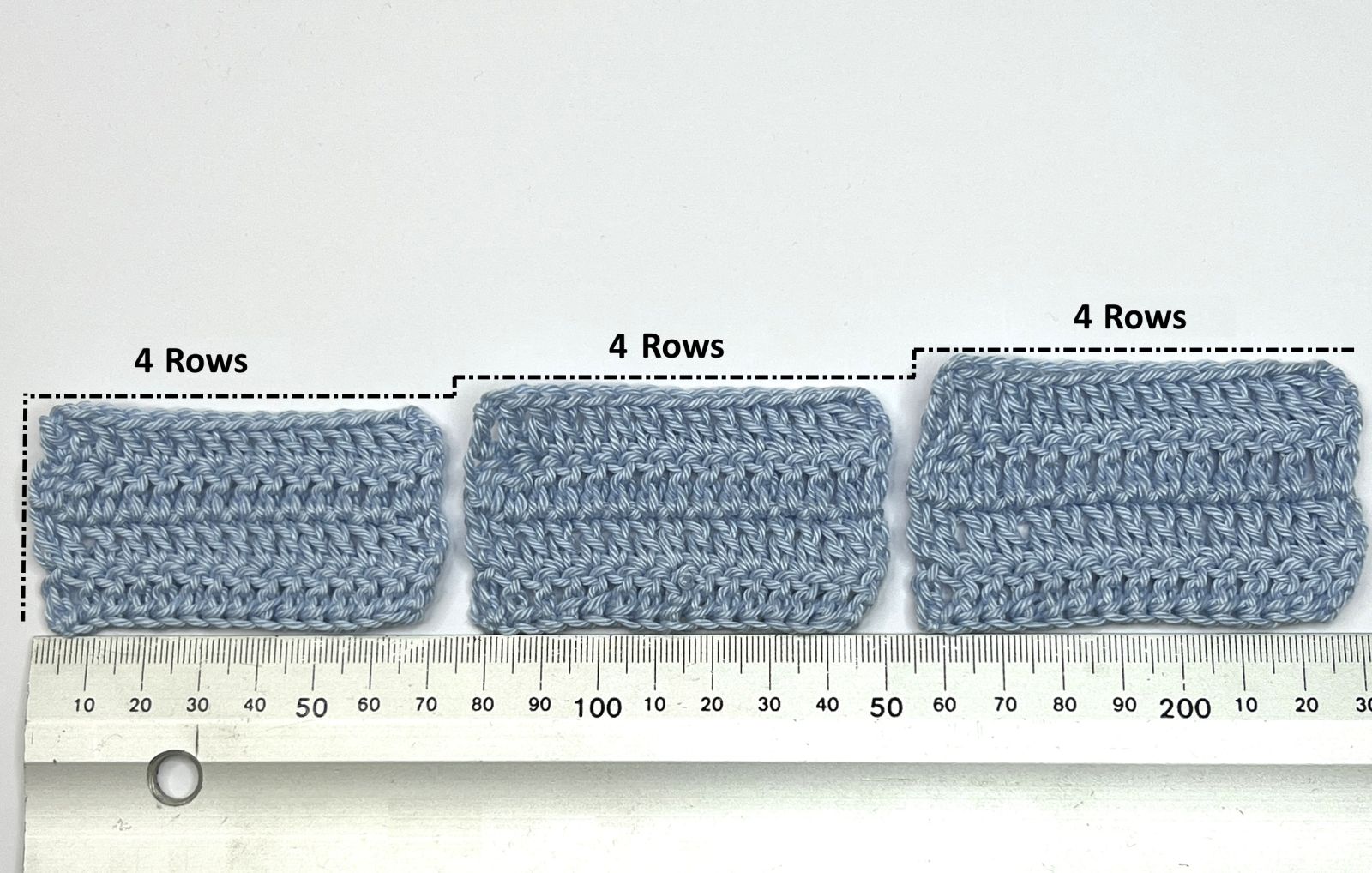
And that is exactly why a crochet piece can match in width but still be noticeably off in height. You can clearly see that in the photo above. Over 4 rows, the difference may seem minimal - but imagine that over 10, 20, or 30 rows ... or in fitted designs where the size has to be accurate down to the centimeter, like my can covers or my lanterns.
Even though I personally never work with gauge swatches, because they do not offer a solution but only reveal the problem: if you have ever wondered why your gauge swatch is only half right, this is often the answer. More on possible solutions later.
Why the same pattern can look different
Maybe you have already experienced two people crocheting the exact same pattern and ending up with two visibly different results.
Here are three examples (see photos below):
My customers crocheted one and the same design, yet you can clearly see that the result on the left looks noticeably compressed, while the result on the right looks stretched.
Boho Summer Lampion (customer projects)
.jpg)
Boho Nights Lampion (customer projects)
.JPG)
.JPG)
Boho Flowers Lampion (customer projects)
.jpg)
None of that is a contradiction. It is simply different “crochet handwriting.”
Crochet is not just a technical sequence of steps. Your own hand is always part of the process. Speed, movement path, yarn control, and tension all shape the result. Some people work more generously, others more compactly. Some naturally give their stitches more height, while others keep them small and controlled.
That is why the same pattern can look soft and flowing in one version, and stable and dense in another - sometimes compact and compressed, sometimes stretched out.
Both can be crocheted neatly. They just do not look identical.
“Rider, Lifter and Yanker”: Three common crochet styles
In the English-speaking crochet world, there are some very vivid terms for these differences: Rider, Lifter, and Yanker.
.jpg)
.jpg)
.jpg)
A Rider usually works in a fairly balanced way. The loop stays at a natural height. The stitch pattern often looks calm and even.
A Lifter pulls the loop a bit higher. That can make stitches taller and softer. The crochet fabric often gets more air and drape, but sometimes also more length than intended - and sometimes more than the design allows.
A Yanker keeps the loop smaller and tighter. That creates denser, more compact stitches. It often adds stability, but it can also mean that rows stay flatter and the piece becomes firmer - and the required height of the crochet project is never fully reached.
Why this matters so much for fit and measurements
As long as you are making simple rectangles, potholders, or uncomplicated scarves, small differences often do not matter much.
But the moment a project needs shape, crochet tension suddenly becomes very important.
Garments, sleeves, armholes, raglan lines, waist shaping, or length-dependent stitch patterns all react sensitively to changes in stitch height. If you tend to work taller, your piece gains length more quickly. If you crochet more compactly, you often need more rows to reach the same height.
And then exactly what many people have already experienced happens: the width fits, but the length does not. Or the design fits differently, even though all the instructions were followed.
This is where it becomes clear that crochet tension is not just a technical detail — it is a decisive factor in fit.
The stitch appearance changes too
It is not only the measurements that are affected by crochet tension. The visual appearance changes too.
Loops that are pulled up higher often make stitches look more open and softer. The crochet fabric looks looser, sometimes more fluid. Shorter loops make the stitch pattern denser, more compact, and often more clearly defined.
Depending on the project, that can be a real advantage.
A loosely draping shawl should naturally look very different from a textured basket or a structured accessory. That is exactly why it is worth seeing crochet tension not only as a source of problems, but also as a design tool.
How to recognize your own crochet style - are you a Yanker, Rider, or Lifter?
.jpg)
For a few stitches, pay very close attention to how you pull up the yarn and at what angle you insert your hook into the work. Does the new loop stay rather short? Do you automatically pull it up a little higher? Or does a calm, medium height happen naturally for you?
Even that small observation can be a real aha moment.
Because many people only realize then that they have a very characteristic way of crocheting. And that same tendency runs through almost every project.
Once you recognize that, you suddenly understand much better why some patterns work beautifully for you while others keep showing small differences. And once you understand what causes it, you can start influencing it.
Can you influence your own crochet tension?
Yes, absolutely.
Of course, part of your personal crochet handwriting will always remain. But if you consciously pay attention to how high or how tight your new loops are, you can deliberately change the way you crochet.
You can learn to work a little looser or a little more compactly. You can guide your stitches more consciously. And depending on the project, you can decide which effect you want in order to achieve the perfect result.
This is especially helpful when a design needs a certain length, a stitch pattern should look more even, or your row gauge is off.
So crochet tension is not something you are helplessly stuck with. It can be understood, observed, and — to a certain extent — controlled.
Your crochet tension is part of your “crochet handwriting”
Perhaps that is the nicest thought of all: the way you crochet is not just a technical habit. It shows your own personal style.
It appears in your stitch pattern, in the way your projects look, and in the overall effect of your finished work. Some people crochet softly and fluidly, others densely and clearly, and others in a very balanced way. None of that is wrong.
It is simply important to recognize and understand it.
Because once you understand how your own hand works, you can decide much more precisely when that style is perfect — and when it may need a slight adjustment for a particular project.
Conclusion: Small movement, big change
Crochet tension is much more than just whether someone works loosely or tightly. It affects stitch height, row appearance, structure, measurements, and fit - often far more than people first realize.
Rider, Lifter, and Yanker are helpful images for something that usually remains invisible. They make it easier to understand why two crochet projects can look different even when made from the same pattern, and why some projects fit perfectly right away while others never turn out quite as expected.
Once you start paying attention to these small movements, you suddenly discover a whole new layer of crochet.
And perhaps that is exactly the difference between “Why does mine look different?” and “Now I finally understand why.”
Finally, the most important part: how you can fix tension issues
For your next crochet project, it is worth taking a very close look for a few stitches. Not at the finished piece. Not at the hook size. But at the exact moment when a new loop is created.
Maybe that is when you will recognize for the first time whether you are more of a Rider, Lifter, or Yanker.
And then, if your crochet piece looks stretched out or compressed, these additional adjustments may help:
-
choose a hook that is half to one full size larger or smaller
-
depending on the structure of the pattern, add extra rounds of sc, hdc, or dc
-
or, if it makes sense, intentionally leave out such rounds
By the way, I am a Rider ☺ the golden middle, apparently.
Have you ever crocheted one of my patterns and wondered why your finished piece turned out too stretched out or rather compressed? Then this topic may be exactly what is behind it. I do not get this kind of feedback often, but it does happen occasionally, as you can see in the lantern examples above.
If you recognize yourself here, feel free to message me and show me your result. I would be very happy to take a look — and maybe I can help you with a few individual adjustment tips so your next attempt fits from the very beginning.
Now I am curious — what do you think: are YOU a Lifter, Rider, or Yanker?
Whichever “species” you belong to, I wish you always lots of joy with crochet and crafting! 🧶🥰


