
.jpg)
Today I’m sharing two new patterns for practical coasters that are wonderfully simple to knit. Especially in summer, when we spend so much time outdoors and constantly battle curious insects landing in our drinks, these little coasters double perfectly as glass covers. Our family loves them — and everyone has already chosen their favorite design.
These little coasters are perfect for using up leftover yarn. They’re wonderfully practical, beautifully decorative, and an absolute joy to knit — plus, they come together in no time. That makes them ideal as a last‑minute gift or a charming little something to bring along to your next summer gathering.
The patterns are worked with a simple mix of knit and purl stitches, making them a wonderful way for beginners to practice and build confidence. But even experienced knitters will enjoy these little in‑between projects. And even with small pieces like these, it’s worth taking a moment to finish the edges neatly. It’s just a tiny bit of extra effort, but it makes every project — big or small — look noticeably better. In this post, I’ll show you two different techniques for creating a clean, beautiful edge stitch.
The first is wonderfully simple and perfect for beginners because it only requires slipping a single stitch. The second, which involves two stitches, is a lovely option for more experienced knitters and results in a firm, elegant edge. So you can gather your materials, here’s the…
Materials list
- Around 10 g of yarn per coaster, such as 100% cotton in your preferred colour, 125 m / 50 g
- 2.5 mm knitting needles
- Darning needle and scissors
Note: You can knit these coasters with any yarn you like. For the cleanest results, I recommend a smooth, non‑fuzzy yarn that can go in the washing machine.
If you use a yarn with a different weight or yardage and end up with a different gauge, the size of your finished coaster will change — and so will the amount of yarn you need. I find 100% cotton to be ideal for projects like this. Whether it’s mercerized or not doesn’t matter here; it’s simply a matter of personal preference.
Required Skills / Abbreviations
- Basic knitting skills (casting on, binding off, knit and purl stitches)
- Abbreviations: the words are not written out in full; instead, only the number of stitches is given, followed by "k" (knit), "p" (purl), or "S" (selvedge stitch)
e.g.: R 7: 4 k, 22 p, 3 k, S (= Row 7: 4 knit stitches, 22 purl stitches, 3 knit stitches, edge stitch)
Size
When using cotton yarn (125 m / 50 g), the finished coaster measures approximately 11.5 cm x 11.5 cm, depending on your personal knitting style.
Tip for advanced knitters: To make a larger coaster, you can, for example, increase the border by knitting more rows at the top and bottom or more stitches on the left and right in garter stitch. You can also add additional rows or stitches in stockinette stitch.
Let’s start by looking at the selvedge stitch
What exactly does “selvedge stitch” mean? A selvedge stitch, sometimes also called “edge stitch” or “border stitch,” is a general term for the stitch(es) on the right and left edges, usually the first and last stitch of a row. These stitches are not part of the actual pattern but are worked in a special way. Knitting a selvedge stitch is worthwhile for several reasons, because
- It creates a neat, sturdy, and attractive edge on your knitted piece
- It gives the knitted piece a more defined shape
- It makes it easier to pick up stitches from the edge or to sew two knitted pieces together
If you come across the term “selvedge stitch” in a pattern but there’s no explanation provided, you can usually choose whichever version works best for you. There are many different ways to knit a selvedge stitch. Below, I’ll show you two that I find work especially well with a knit‑purl pattern.
Instructions for the Selvedge Stitch Variation 1
I use this selvedge stitch for the washcloths and dish towels, as well as for the solid-color baby blankets with a “knit-purl pattern” available in my shop. It looks neat, is easy to make, and is therefore ideal for beginners—especially in the early stages, when you already need to focus on the pattern, the edge stitch should be easy to remember and as foolproof as possible.
The selvedge stitch is worked starting from the very first row.
Selvedge stitch on the right edge (= first stitch at the beginning of the row): knit
Then follow the pattern as directed until you have only one stitch left on the needle.
Selvedge stitch on the left edge (= last stitch at the end of the row):
Slip as if to purl, with yarn front:
.jpg)
Turn.
Selvedge stitch (you're now back at the right edge): knit as usual.
This is what the edge will look like later:
.jpg)
Instructions for the Selvedge Stitch Variation 2
This selvedge stitch spans the first two or last two stitches of a row. It isn’t complicated, but it requires a few more steps and therefore carries a greater risk of missing a step. That’s why I recommend this variation for more experienced knitters.
This variation can also be used for all washcloths and dish towels, as well as for the solid-color baby blankets with a “knit-purl pattern” from my shop. Please note that you will need to cast on two more stitches than indicated in the instructions (the edge stitch counts as 2 stitches).
This selvedge stitch is also worked starting from the very first row.
Selvedge stitch on the right edge (= the first two stitches at the beginning of the row): knit both stitches together through the back loop:
.jpg)
Next, bring the yarn from the back over the right needle (i.e., exactly the opposite direction of a yarn over):
.jpg)
You have now picked up the stitch that was just decreased by knitting together. Then follow the pattern as directed until you have only two stitches left on the needle.
Selvedge stitch on the left edge (= last two stitches at the end of the row):
Slip both stitches as if to purl with yarn front:
.jpg)
Turn. Now work the selvedge stitch on the right edge again.
This is what the edge will look like later:
.jpg)
A direct comparison of both edges
.jpg)
You can already see the difference quite clearly in the photo, but you’ll notice it even more once you’ve tried both versions and can feel the contrast for yourself. Variation 1 is neat, gives a clean finish, and has a slightly softer, looser character.
Compared to the first version, variation 2 is slightly denser, firmer, and more stable. Even in this small swatch, it’s easy to see how well it helps the fabric hold its shape, which becomes even more noticeable in bigger projects. Both versions work well for a neat edge, but if you prefer something extra sturdy and nicely defined, I’d recommend giving variation 2 a try.
Instructions for Coaster 1 – Popsicle
That immediately makes me think of a delicious vanilla ice cream with a dark chocolate coating, studded with little crunchy nut pieces—mmm...
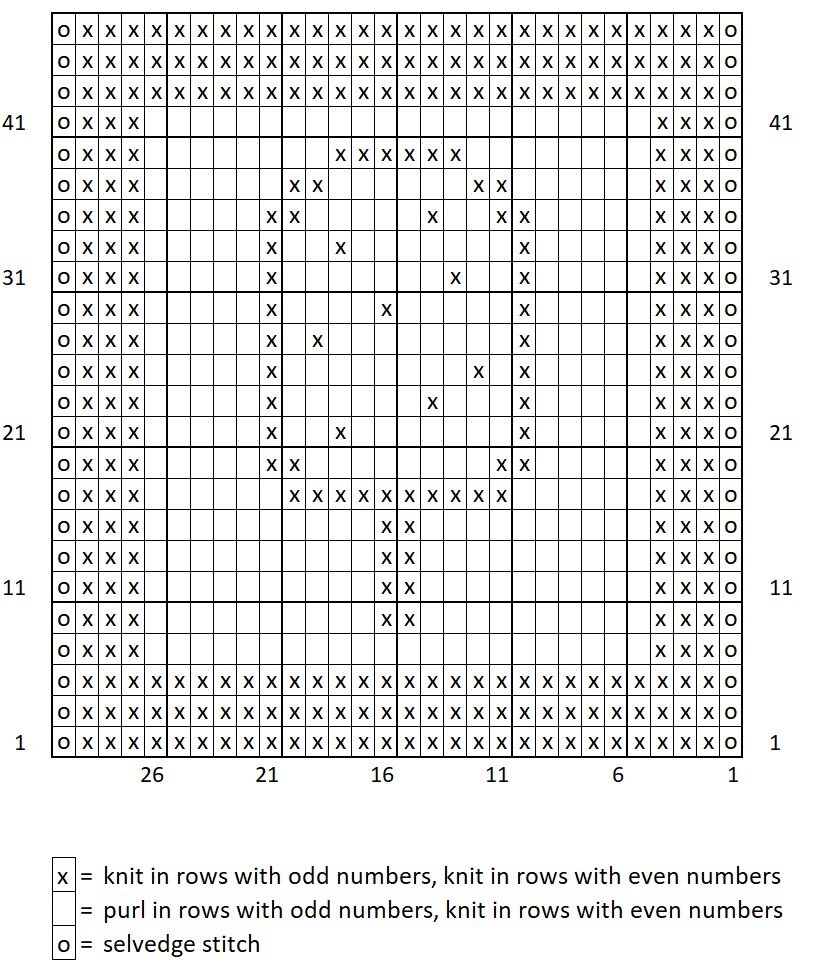
This pattern is quite easy to knit. I therefore recommend that beginners start with this pattern and use variation 1 of the selvedge stitch.
In this coaster, the pattern is created by working the motif and the border in garter stitch, while the background is worked in stockinette stitch. The motif is being developed in the rows with odd numbers (on the wrong side), where you work knit stitches for the pattern and purl stitches for the background. The rows with even numbers (right side) are worked entirely in knit stitches.
The rows with odd numbers are read from right to left in the chart, i.e., in the direction of knitting.
Cast on 30 stitches.
Tip for experienced knitters: If you want to use the selvedge stitch in variation 2, please cast on 2 additional stitches, for a total of 32 stitches. Then replace the first knit stitch in the written instructions with the selvedge stitch over two stitches. As an example, row 1 would then be worked as follows: S (= selvedge stitch over two stitches), 28 knit, S (= selvedge stitch over two stitches) = 32 stitches.
Written instructions (with selvedge stitch variation 1):
R 1: 29 k, S
R 2: 29 k, S
R 3: 29 k, S
R 4: 29 k, S
R 5: 29 k, S
R 6: 29 k, S
R 7: 4 k, 22 p, 3 k, S
R 8: 29 k, S
R 9: 4 k, 10 p, 2 k, 10 p, 3 k, S
R 10: 29 k, S
R 11: 4 k, 10 p, 2 k, 10 p, 3 k, S
R 12: 29 k, S
R 13: 4 k, 10 p, 2 k, 10 p, 3 k, S
R 14: 29 k, S
R 15: 4 k, 10 p, 2 k, 10 p, 3 k, S
R 16: 29 k, S
R 17: 4 k, 6 p, 10 k, 6 p, 3 k, S
R 18: 29 k, S
R 19: 4 k, 5 p, 2 k, 8 p, 2 k, 5 p, 3 k, S
R 20: 29 k, S
R 21: 4 k, 5 p, 1 k, 7 p, 1 k, 2 p, 1 k, 5 p, 3 k, S
R 22: 29 k, S
R 23: 4 k, 5 p, 1 k, 3 p, 1 k, 6 p, 1 k, 5 p, 3 k, S
R 24: 29 k, S
R 25: 4 k, 5 p, 1 k, 1 p, 1 k, 8 p, 1 k, 5 p, 3 k, S
R 26: 29 k, S
R 27: 4 k, 5 p, 1 k, 8 p, 1 k, 1 p, 1 k, 5 p, 3 k, S
R 28: 29 k, S
R 29: 4 k, 5 p, 1 k, 5 p, 1 k, 4 p, 1 k, 5 p, 3 k, S
R 30: 29 k, S
R 31: 4 k, 5 p, 1 k, 2 p, 1 k, 7 p, 1 k, 5 p, 3 k, S
R 32: 29 k, S
R 33: 4 k, 5 p, 1 k, 7 p, 1 k, 2 p, 1 k, 5 p, 3 k, S
R 34: 29 k, S
R 35: 4 k, 5 p, 2 k, 2 p, 1 k, 5 p, 2 k, 5 p, 3 k, S
R 36: 29 k, S
R 37: 4 k, 6 p, 2 k, 6 p, 2 k, 6 p, 3 k, S
R 38: 29 k, S
R 39: 4 k, 8 p, 6 k, 8 p, 3 k, S
R 40: 29 k, S
R 41: 4 k, 22 p, 3 k, S
R 42: 29 k, S
R 43: 29 k, S
R 44: 29 k, S
R 45: 29 k, S
R 46: 29 k, S
R 47: 29 k, S
Then loosely bind off all stitches. I use the very simple method of binding off by slipping:
Knit two stitches. Using the left needle, slip the second-to-last knit stitch over the last knit stitch. Knit one stitch and slip the second-to-last stitch over the last stitch again. Repeat until the end of the row. Knit relatively loosely so that the cast-off edge is elastic, but not too loosely. After casting off a few stitches, check whether the cast-off edge is too tight or too loose, and adjust your tension if necessary.
.jpg)
Cut the thread and pull it through. Sew up all the loose ends, and your first coaster is ready!
.jpg)
Instructions for Coaster 2 – Ice Cream Cone
The ice cream vendor was generous — perhaps a bit too generous — and now the scoops are perched precariously on the crisp cone, already beginning to drip. There’s only one thing to do: circle it with quick, careful licks…😉
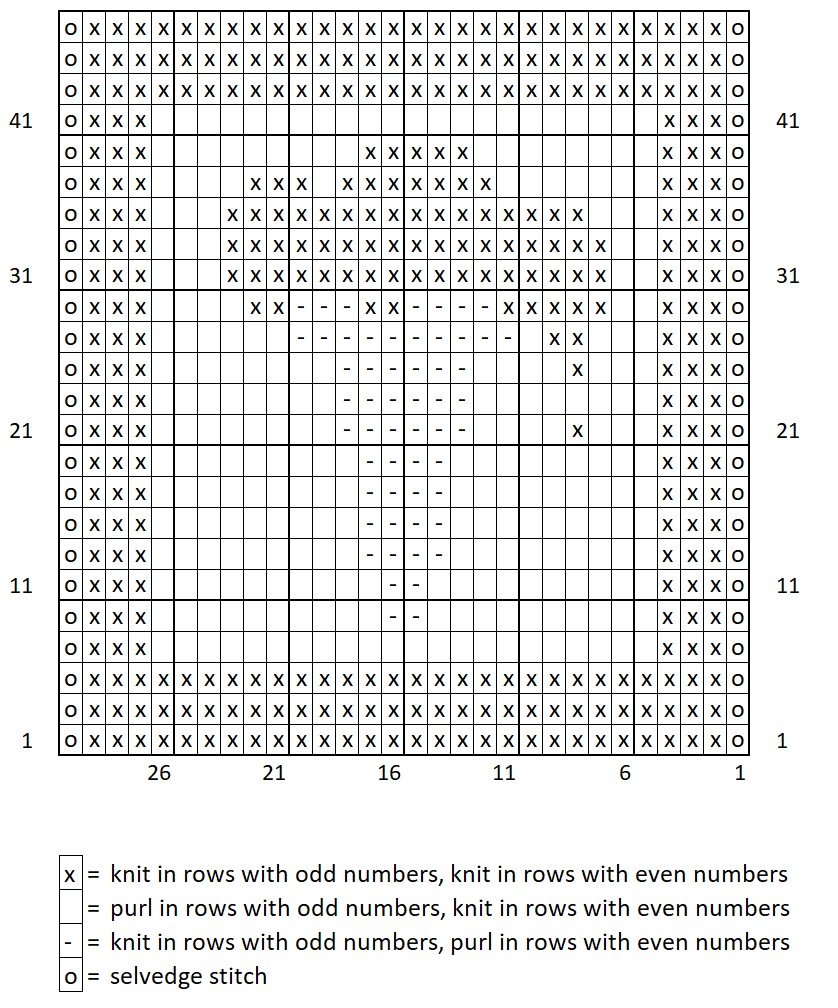
This pattern is actually just as easy to knit, but it includes an additional stitch combination.
Here, too, the pattern is created using garter stitch for the border and part of the motif, while the background remains stockinette stitch. Additionally, there is a section of the motif (the ice cream cone) that is worked in reverse stockinette stitch. The pattern is thus being developed not only in the rows with odd numbers on the wrong side, but also in the rows with even numbers.
If you want to follow the knitting chart, this means that on the rows with even numbers (on the right side), you CANNOT knit all stitches; instead, you must knit or purl depending on the symbol in the chart.
The rows with odd numbers in the chart are read from right to left, i.e., in the direction of knitting. Please note that for the rows with even numbers, you must read the chart in the opposite direction, i.e., from left to right. The easiest way to work is to follow the written instructions.
Cast on 32 stitches
Tip for beginners: If you’d like to continue using the selvedge stitch from variation 1, please cast on 2 fewer stitches, for a total of 30 stitches. Then, following the written instructions, knit the selvedge stitch at the beginning of the row as a knit stitch and the selvedge stitch at the end of the row as a slipped stitch, as described above. For example, row 1 would be worked as follows: S (= 1 knit), 28 knit, S (= slip stitch as if to purl) = 30 stitches.
Written instructions (with selvedge stitch variation 2):
R 1: S, 28 k, S
R 2: S, 28 k, S
R 3: S, 28 k, S
R 4: S, 28 k, S
R 5: S, 28 k, S
R 6: S, 28 k, S
R 7: S, 3 k, 22 p, 3 k, S
R 8: S, 28 k, S
R 9: S, 3 k, 10 p, 2 k, 10 p, 3 k, S
R 10: S, 13 k, 2 p, 13 k, S
R 11: S, 3 k, 10 p, 2 k, 10 p, 3 k, S
R 12: S, 13 k, 2 p, 13 k, S
R 13: S, 3 k, 9 p, 4 k, 9 p, 3 k, S
R 14: S, 12 k, 4 p, 12 k, S
R 15: S, 3 k, 9 p, 4 k, 9 p, 3 k, S
R 16: S, 12 k, 4 p, 12 k, S
R 17: S, 3 k, 9 p, 4 k, 9 p, 3 k, S
R 18: S, 12 k, 4 p, 12 k, S
R 19: S, 3 k, 9 p, 4 k, 9 p, 3 k, S
R 20: S, 12 k, 4 p, 12 k, S
R 21: S, 3 k, 3 p, 1 k, 4 p, 6 k, 8 p, 3 k, S
R 22: S, 11 k, 6 p, 11 k, S
R 23: S, 3 k, 8 p, 6 k, 8 p, 3 k, S
R 24: S, 11 k, 6 p, 11 k, S
R 25: S, 3 k, 3 p, 1 k, 4 p, 6 k, 8 p, 3 k, S
R 26: S, 11 k, 6 p, 11 k, S
R 27: S, 3 k, 3 p, 2 k, 1 p, 10 k, 6 p, 3 k, S
R 28: S, 9 k, 10 p, 9 k, S
R 29: S, 3 k, 2 p, 16 k, 4 p, 3 k, S
R 30: S, 9 k, 3 p, 2 k, 4 p, 10 k, S
R 31: S, 3 k, 2 p, 17 k, 3 p, 3 k, S
R 32: S, 28 k, S
R 33: S, 3 k, 2 p, 17 k, 3 p, 3 k, S
R 34: S, 28 k, S
R 35: S, 3 k, 3 p, 16 k, 3 p, 3 k, S
R 36: S, 28 k, S
R 37: S, 3 k, 7 p, 7 k, 1 p, 3 k, 4 p, 3 k, S
R 38: S, 28 k, S
R 39: S, 3 k, 8 p, 5 k, 9 p, 3 k, S
R 40: S, 28 k, S
R 41: S, 3 k, 22 p, 3 k, S
R 42: S, 28 k, S
R 43: S, 28 k, S
R 44: S, 28 k, S
R 45: S, 28 k, S
R 46: S, 28 k, S
R 47: S, 28 k, S
Bind off as described above.
.jpg)
I hope you enjoy your summery coasters or glass covers! Please do share your finished pieces in the gallery.
If you’ve enjoyed making these coasters and would like to knit some more designs, you’ll find the patterns for the matching “Summerdrinks” coasters in my shop:
.jpg)
Knitting pattern "Summerdrinks"
One last tip: These handy little pads are wonderfully versatile — you can even use them as reusable make‑up removal pads. It’s a very hygienic option: simply knit a few, use each one once, and toss them straight into the wash so you always have a fresh pad ready. They’re a more eco‑friendly choice compared to disposable make‑up wipes.
And of course I’m curious too – did you already know about the selvedge stitch over two stitches? Or was this your first time trying it? What do you think of it? I look forward to reading your comments below this blog post. Feel free to leave any questions, requests or suggestions there at any time😊
Kind regards,
Sonja from a-mano


