Love crisp stitch patterns and clean repeats? Discover PDF downloads with easy-to-read crochet charts, clear repeat sections, and notes on hook size, yardage, and tension. Show more
Love crisp stitch patterns and clean repeats? Discover PDF downloads with easy-to-read crochet charts, clear repeat sections, and notes on hook size, yardage, and tension. With the right blocking, you can open up your lace design to the width and shape you want.
Lace patterns come to life through chains, arches, and clear repeats, creating featherlight shawls, stoles, and shoulder wraps for everything from everyday wear to special occasions. To make sure the shape, size, and pattern turn out just right, it’s worth taking a quick look at the pattern details before you start.
Quick choice
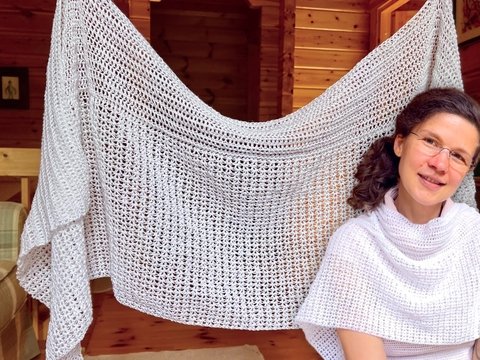
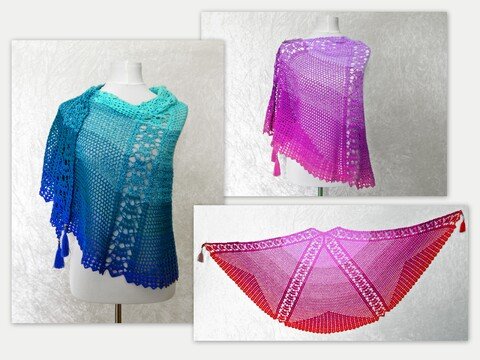
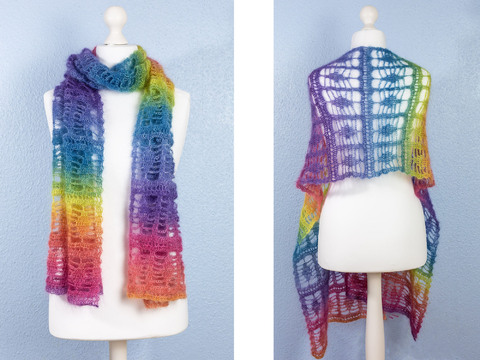
✓Shape: Triangle shawls are a classic; crescent shawls often sit better on the shoulders, while rectangular shawls (stoles) can be draped in particularly versatile ways.
✓Difficulty level: “Intermediate” is often standard because you should be comfortable reading charts and repeating pattern sections accurately.
✓Look & occasion: Whether you’re making summer lace, a cozy stole, or a bridal piece, decide whether you want your shawl to look casual, romantic, or especially delicate.
What to look out for
Pattern format: Is the pattern written out or presented as a crochet chart? Charts are often easier to follow for complex lace.
Language: Many lace patterns use international terms. Check whether German, US, or UK terminology is used (“double crochet” means different things in US and UK terminology!).
Yarn length: Check the specified meterage, as the yarn length determines whether you have enough for your shawl; weight is usually less important.
Hook size: Lace is often crocheted with a larger hook than the yarn label recommends to give the pattern an airy drape.
Common pitfalls
Appearance before blocking: Don’t be alarmed—unblocked lace often looks “lumpy.” The pattern only opens up when it’s blocked.
Pattern repeat errors: A mistake in a lower row carries through the work. Use stitch markers after each pattern repeat and check your stitch count regularly.
Securing yarn ends: In very open patterns, it’s difficult to weave in ends invisibly. Plan to place yarn ends in denser sections or along edges, and use tried-and-tested techniques for weaving in ends as a guide.
Uneven tension: If the shawl becomes wavy or pulls in, it often helps to deliberately keep your yarn tension loose and choose a suitable hook. For guidance, see how to choose the right crochet hook.
Frequently Asked Questions
A lace shawl is a crocheted shawl with openwork patterns created using chains, arches, and pattern repeats.
Look at the preview or description: if it contains many English technical terms or mentions US or UK terminology, you should be comfortable with them. If you need more help, check out the tips on finding patterns on the site.
That depends on the size, pattern, and yarn weight. Use the quantities in meters and grams given in the pattern, and plan for extra yarn accordingly if you make adjustments (larger or smaller).
Many lace patterns only look even and “open” after blocking. The pattern will usually tell you whether it’s necessary; it’s often recommended for highly textured lace.
A stole is usually longer and more rectangular, while a shawl is more often triangular or crescent-shaped. The key factors are the stated measurements and how you want to wear it.
To enhance user experience, we use cookies, including for analysis, optimization, and advertising purposes, in accordance with our Privacy Policy and Cookie Policy. Google Ads uses cookies and your IP address to measure for us which ads lead to purchases (how Google uses data). Some of our partner services are located outside the EU. You can change your settings at any time. If you select "Decline", we will only use essential cookies.